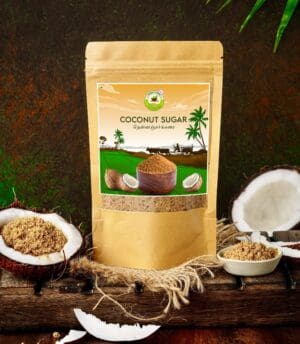
Coconut sugar is an unrefined sweetener made by boiling down the sap collected from coconut palm flower stalks until it crystallises into fine golden brown granules. It tastes mildly caramel and nutty, dissolves easily, and can replace white sugar spoon for spoon in most Indian sweets, filter coffee, batters and baked items.
If you have been reading packet labels at the kirana shop lately, you have probably seen coconut sugar sitting beside jaggery and country sugar. It is one of the oldest sweeteners along the Kerala and Tamil Nadu coast, and it is now reaching kitchens across India.
This guide covers what coconut sugar actually is, how it tastes, how it behaves in Indian cooking, how it compares with naatu charkarai and jaggery, and how to store it in humid Indian weather.
What exactly is coconut sugar?
Coconut sugar comes from the flower of the coconut palm, not from the fruit or the water inside it. Tappers climb the tree, score the unopened flower spathe, and tie a pot underneath to collect the sap that drips out. This sap is called neera in most of India.
Fresh neera is pale, cloudy and sweet. It is boiled in wide open pans over a wood fire until most of the water evaporates and the sugars thicken into a dark syrup. As it cools, the syrup is stirred continuously so it sets as loose grains instead of a solid block.
That is the whole process. No bleaching, no sulphur, no molasses stripping. What you get is a free flowing brown granule that still carries the colour and aroma of the sap it came from. Our 250g pack of coconut sugar at Rs 210 is made exactly this way and arrives as loose grains rather than a hard cake.
One point worth clearing up: coconut sugar does not taste like coconut. People expect that and are often surprised. The coconut flavour sits in the oil and the flesh, not in the flower sap.
What coconut sugar tastes like
The flavour is closest to a light muscovado or a mild toffee. There is a rounded caramel note from the slow boiling, a faint nuttiness, and a very slight savoury edge at the finish that keeps it from tasting flat.
Compared with white sugar, it is less sharp. White sugar hits the tongue as pure sweetness and disappears. Coconut sugar lingers a little and leaves a warm aftertaste, which is why it suits coffee, chikki and anything with ghee in it.
Compared with gur or jaggery, it is cleaner and far less earthy. Jaggery can turn smoky or slightly bitter depending on the batch. Coconut sugar stays mellow and is more consistent from pack to pack.
Colour matters too. Expect a mid to deep brown with a little variation between batches, because the sap changes through the season. A pack that looks uniformly pale or oddly bright has usually been mixed with refined sugar.
How to use coconut sugar in Indian cooking
The simplest rule: swap it one to one for white sugar by volume. One teaspoon of coconut sugar for one teaspoon of sugar. The grains are a touch coarser, so give it a few extra seconds to dissolve in cold liquids.
Coffee and tea. This is where most households start. Two spoons in filter kaapi with hot milk works beautifully because the caramel note sits well with the chicory. In masala chai it holds its own against ginger and elaichi.
Payasam and kheer. Use it in semiya payasam, paal payasam or sabudana kheer. It will tint the milk a light beige, which is normal. Add it at the end, off the flame, and stir until dissolved so the milk does not split.
Halwa and sweets. Carrot halwa, rava kesari and wheat halwa all take coconut sugar well. The brown colour actually deepens the look of a carrot halwa.
Baking. It works in cakes, cookies, banana bread and brownies at the same weight as brown sugar. Because it is slightly drier than brown sugar, you may want one extra spoon of milk or curd in the batter. Baked items will brown a shade faster, so check five minutes early.
Chutneys and sambar. A small pinch balances tamarind in a puli kuzhambu or a tomato chutney. Use less than you would jaggery, since coconut sugar is not as assertive.
Laddu and chikki. It melts into a workable syrup for peanut chikki and til laddu, though the set is slightly softer than with jaggery.
Coconut sugar, country sugar and jaggery: picking between them
These three get lumped together as natural sweeteners, but they behave very differently in a pan, and most Indian kitchens end up keeping two of them.
Country sugar, known as naatu charkarai in Tamil Nadu and nattu sakkarai in some regions, is made from sugarcane juice rather than palm sap. It is lighter in colour than jaggery, sandy in texture, and has a clean cane sweetness with a mild molasses note. Many families use it as their everyday sugar substitute in coffee, upma and sweets. A 500g pack of country sugar or naatu charkarai at Rs 126 is the usual starting point if you want quantity for daily cooking.
There is also a herbal version, prepared with traditional ingredients ground in along with the sugarcane. Our herbal country sugar, or mooligai naatucharkarai, at Rs 131.25 has a slightly darker colour and a more layered, spiced flavour. People who find plain country sugar too simple in payasam tend to prefer this one.
Jaggery comes as a solid block or round that needs grating or chopping. It is the strongest flavoured of the lot and the most variable.
A practical way to choose:
- Coffee, tea, baking and anything delicate: coconut sugar, because it dissolves fine and stays mellow.
- Everyday cooking in volume: country sugar, which is the most economical per kilo.
- Payasam and festival sweets where you want depth: herbal country sugar.
- Puli kuzhambu, ellu urundai, strong traditional sweets: jaggery.
How to store coconut sugar in Indian weather
Humidity is the only real problem. Coconut sugar pulls moisture from the air and will clump into a solid lump if left in an open or loosely shut container, especially during the monsoon or in coastal cities like Chennai, Kochi and Mumbai.
Keep it in a dry airtight glass or steel dabba, away from the stove and the sink. Use a dry spoon every time. A wet spoon is the fastest way to ruin a pack.
If it does harden, it is still perfectly good. Break it up with a fork, or pulse it briefly in a mixie, and it goes back to loose grains. Some people drop a bay leaf in the jar to keep it free flowing.
It does not need refrigeration and keeps for a long time if dry. Refrigeration actually causes condensation when you take the jar out, which makes clumping worse.
Buying coconut sugar online in India
Check three things on the label: that it says coconut sap or neera rather than just palm sugar, that there is no added refined sugar in the ingredients, and that the pack is sealed and moisture proof.
Price is a reasonable signal. Real coconut sugar needs a tapper climbing trees daily and hours of boiling for a small yield, so very cheap packets are usually blended.
Farm2Home sources directly from small producers and delivers across India. You can order coconut sugar in a 250g pack on its own, or add naatu charkarai and mooligai naatucharkarai to the same order if you want to compare all three in your own kitchen.
Frequently asked questions about coconut sugar
Does coconut sugar taste like coconut?
No. It is made from the sap of the coconut flower, not from the fruit or the coconut water. The taste is mildly caramel and nutty, closer to a light toffee than to anything coconut flavoured.
Can I replace white sugar with coconut sugar in the same quantity?
Yes, use it one to one by volume or by weight. The grains are slightly coarser, so allow a few extra seconds for it to dissolve in cold drinks like nimbu pani or buttermilk.
What is the difference between coconut sugar and naatu charkarai?
Coconut sugar is made from coconut palm flower sap and tastes caramel and nutty. Naatu charkarai, or country sugar, is made from sugarcane juice and has a lighter, cleaner cane sweetness. Both are unrefined and come as loose grains.
Why has my coconut sugar turned into a hard lump?
It has absorbed moisture from the air. This is normal in Indian humidity and does not spoil it. Break the lump with a fork or pulse it in a mixie, then store it in a properly airtight dabba and always use a dry spoon.
Can coconut sugar be used for baking?
Yes. Substitute it for brown sugar at the same weight in cakes, cookies and brownies. It is a little drier, so add a spoon of milk or curd to the batter, and check your bake about five minutes early since it browns faster.
Is coconut sugar suitable for payasam and halwa?
It works well in both. Add it off the flame in milk based payasam so the milk does not split. Expect the dish to take on a light beige or deeper brown shade, which is simply the natural colour of the sugar.
How much does coconut sugar cost at Farm2Home?
A 250g pack of coconut sugar is Rs 210. Country sugar is Rs 126 for 500g and herbal country sugar is Rs 131.25. Farm2Home delivers across India.