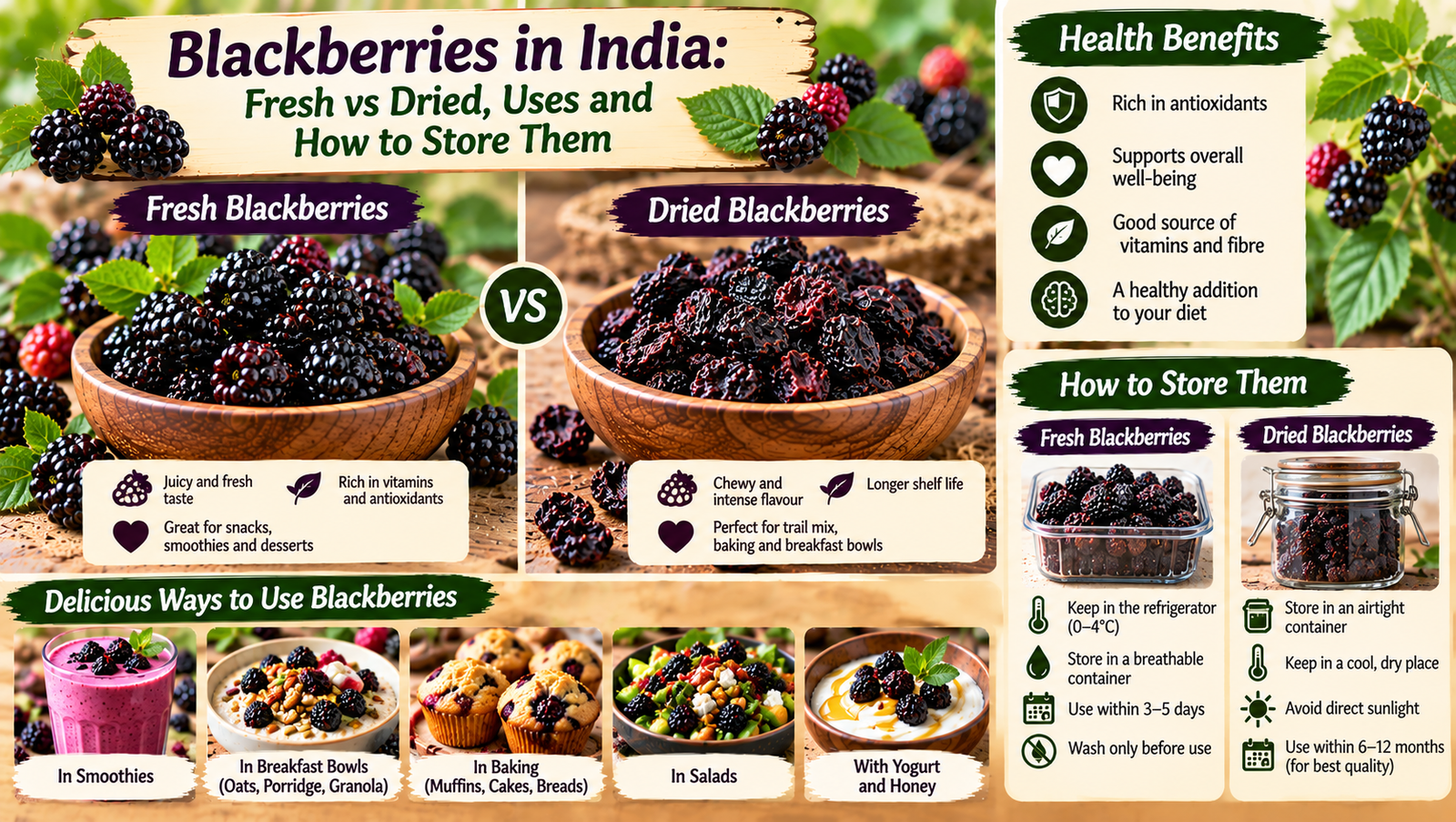
Blackberries are small, deep-purple berries with a sweet-tart taste, eaten fresh, dried, or stirred into breakfasts and desserts. In India they are increasingly available in dried form, which keeps far longer than fresh fruit and works well in porridges, trail mixes, baking and festive sweets.
If you have been searching for blackberries in India, you have probably noticed something confusing: the name gets used for more than one fruit. This guide clears that up, explains what dried blackberries actually taste like, and shows practical ways to use them in everyday Indian cooking.
What are blackberries?
Blackberries are an aggregate fruit, which means each berry is made up of many tiny segments called drupelets clustered around a core. That structure is what gives them their characteristic bumpy surface and their slightly chewy bite. They grow on thorny brambles and ripen from green through red to a deep, glossy purple-black.
The flavour sits between sweet and tart. A fully ripe blackberry is noticeably sweeter than a raspberry and less sharp than a redcurrant, with a faint floral note underneath. Underripe ones lean sour, which is why colour matters so much when picking them.
Blackberries, jamun and mulberries: the Indian confusion
Three different fruits get called “blackberry” in India, and they are not the same thing:
- Blackberry — the bramble fruit described above, bumpy and made of drupelets.
- Jamun (Indian blackberry, Syzygium cumini) — a smooth, oval, single-seeded fruit with a purple flesh that stains the tongue. Common across India in summer. Despite the English name, it is botanically unrelated.
- Mulberry (shahtoot) — longer and more cylindrical, growing on trees rather than brambles, with a milder and much sweeter flavour.
If a recipe calls for blackberries and you substitute jamun, expect a very different result. Jamun is more astringent and has a large stone; blackberries are softer and seedier throughout.
Fresh versus dried blackberries
Fresh blackberries are highly perishable. They bruise easily, mould within a few days, and are difficult to transport, which is why they are expensive and inconsistently available in most Indian cities.
Dried blackberries solve the logistics problem. Removing the water concentrates the sugars and the flavour, so the taste becomes more intense and raisin-like, with the tartness still present but rounded off. The texture turns chewy rather than juicy.
For most Indian kitchens, dried is the more practical format. It stores for months in an airtight jar, needs no refrigeration, and can be used straight from the packet. Our dried black berries in a 250g pack are priced at ₹341.25 and are stocked for delivery across India.
How to use blackberries in Indian cooking
Breakfast
Stir a handful of dried blackberries into hot porridge or any millet-based breakfast mix during the last two minutes of cooking. They soften slightly and release colour into the dish. They also work scattered over curd with a drizzle of honey, or folded into overnight oats, where they rehydrate on their own by morning.
Baking and sweets
Dried blackberries behave much like raisins in baking, so they can be swapped in one-for-one in cakes, muffins and cookies. Toss them in a spoon of flour before folding them into batter and they are less likely to sink. They also work chopped into barfi, halwa and laddoo mixtures where you want a tart note to cut the sweetness.
Trail mixes and snacking
Combined with almonds, cashews, walnuts and pumpkin seeds, dried blackberries make a straightforward travel snack that does not need refrigeration. The tartness balances the richness of the nuts. This is the easiest way to use them if you are not cooking much.
Drinks and compotes
Simmer dried blackberries in a little water with a strip of lemon peel for about ten minutes and they break down into a loose compote, good over ice cream, kulfi, pancakes or cheesecake. Steeping them in hot water also gives a deep pink infusion that can be served warm or chilled.
How to store blackberries
Keep dried blackberries in an airtight glass or steel container, away from direct sunlight and the heat of the stove. In Indian humidity, an airtight seal matters more than anything else, since the fruit will absorb moisture from the air and turn sticky if left exposed.
If you live somewhere particularly humid, such as a coastal city during monsoon, the refrigerator is the safer option. Let the jar come to room temperature before opening it, otherwise condensation forms inside and introduces the moisture you were trying to avoid.
Fresh blackberries, if you find them, should be refrigerated unwashed in a single layer and used within two to three days. Wash them only just before eating, because water on the skin accelerates spoilage.
How to choose good dried blackberries
Look for berries that are still pliable rather than rock-hard. A good dried blackberry gives slightly when pressed. Colour should be deep and even; a dusty grey cast usually means age or poor storage. Avoid packs where everything has clumped into one solid block, which indicates moisture got in at some point.
Frequently asked questions
Are blackberries and jamun the same fruit?
No. Jamun is often called Indian blackberry in English, but it is a different species entirely. Jamun is smooth-skinned with a single large seed, while a true blackberry is bumpy and made up of many small segments. They taste noticeably different, with jamun being more astringent.
Can I use dried blackberries instead of fresh?
Yes, in most cooked applications. Use roughly a third of the quantity by weight, since drying removes most of the water. For recipes where juiciness matters, such as a fresh fruit salad, soak them in warm water for fifteen minutes first.
Do dried blackberries need to be soaked?
Not for snacking, baking or trail mixes, where the chewy texture is the point. Soak them when you want them plump, such as in a compote or when scattering over curd.
How long do dried blackberries last?
Stored airtight and away from heat, they keep for several months. Check the pack date and use your judgement: if they smell fermented or feel damp, discard them.
What do blackberries taste like?
Sweet with a clear tart edge and a faint floral note. Dried blackberries taste more concentrated and raisin-like than fresh ones, with the sweetness more forward and the tartness softened.
Where can I buy blackberries in India?
Fresh blackberries are difficult to source consistently outside a few metro grocers. Dried blackberries are easier to find online. Farm2Home stocks dried black berries in 250g packs with delivery across India.
In short
Blackberries are a bramble fruit with a sweet-tart flavour, not to be confused with jamun or mulberry despite the overlapping names. In the Indian context, the dried form is the practical one: it stores well without refrigeration, survives the journey, and slots easily into porridges, baked goods, trail mixes and compotes. Buy pliable berries with an even deep colour, keep them sealed against humidity, and they will stay good for months.