
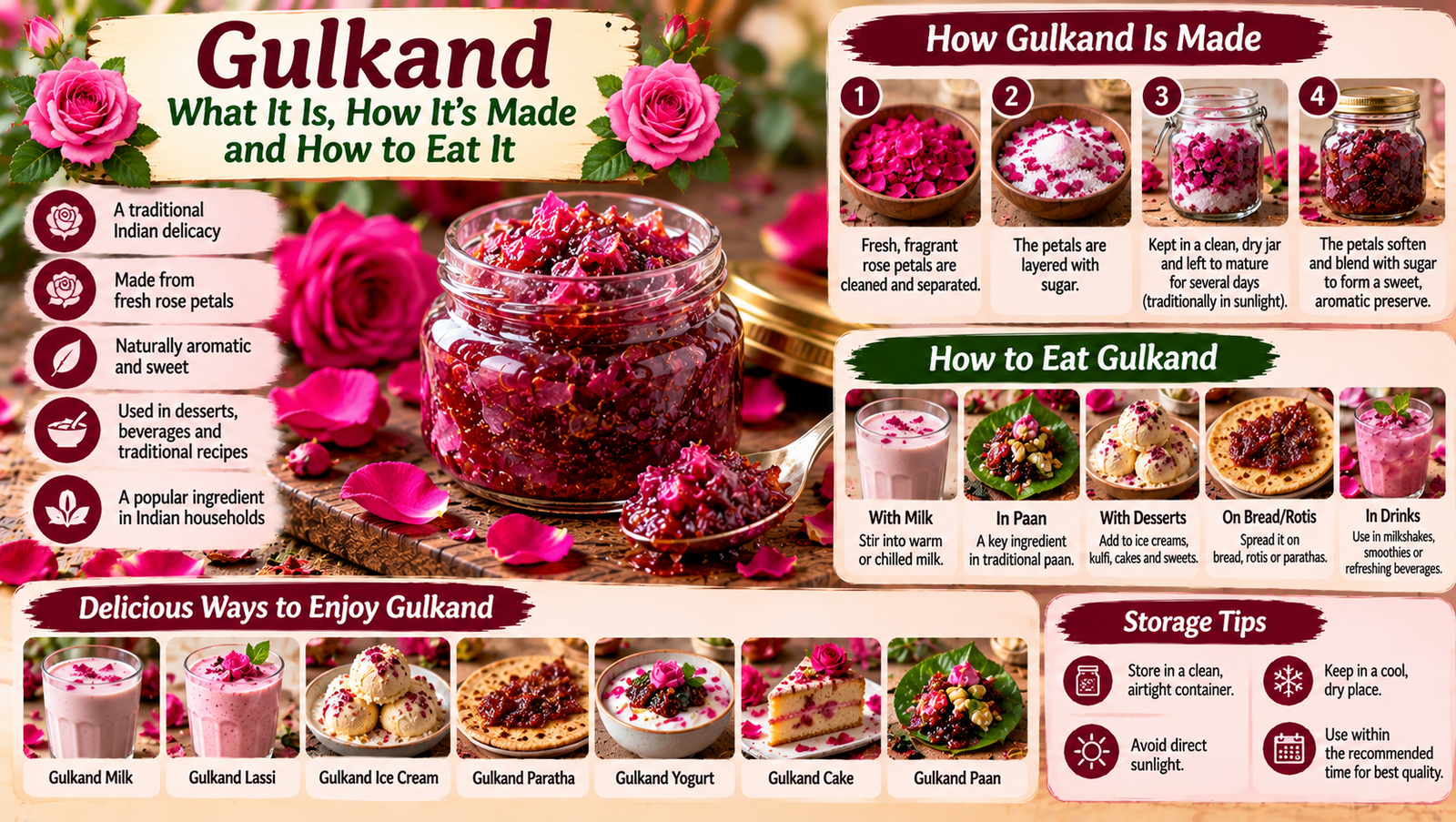
Gulkand is a traditional Indian rose petal preserve made by layering fresh, fragrant rose petals with sugar and leaving the mixture to mature until it turns into a soft, dark, jam-like spread. It tastes sweet and intensely floral, and it is eaten by the spoon, stirred into milk, or used as a paan and dessert filling.
If you have eaten a sweet paan at a wedding, you have almost certainly eaten gulkand. It is the dark, sticky, perfumed layer tucked inside the betel leaf, and it is the reason the whole thing smells like a rose garden. Outside the paan shop, though, most people are not quite sure what to do with a jar of it.
This guide covers what gulkand actually is, how it is made, what it tastes like, the Indian ways to eat it, and how to pick a good jar. It is written for anyone standing over a jar wondering whether it is worth buying and what happens after they open it.
What is gulkand made of?
Real gulkand has a very short ingredient list: rose petals and sugar. That is the whole recipe. Some makers add a little cardamom or a few strands of saffron, and some traditional versions include small amounts of other aromatics, but the base is always petals and sugar.
The petals are not the long-stemmed florist roses sold for bouquets. Those are bred for looks and travel, and they have almost no scent. Gulkand is made from heavily perfumed desi roses, most often the Edward rose grown around Chennai and in parts of Tamil Nadu, or the Damask-type roses grown in Rajasthan around Pushkar and in Uttar Pradesh near Kannauj. The flower is chosen entirely for aroma.
Petals are separated by hand, the bitter white heel at the base is removed, and the clean petals are layered with sugar in a glass or ceramic jar. The sugar draws moisture out of the petals, dissolves into a syrup, and the whole thing slowly collapses into a thick dark preserve. Traditionally the jar is left in the sun for a few weeks and stirred every day. Sunlight and time do the work, not heat or boiling.
Why the colour goes dark
Fresh pink petals and white sugar make a bright pink mixture on day one. By the end of maturing, good gulkand is a deep maroon, almost brown. That darkening is normal and is a sign the preserve has matured properly. A jar that is still shocking pink after months has usually been coloured or rushed.
What does gulkand taste like?
It tastes like sweet roses, which sounds obvious but is worth taking seriously, because floral flavours divide people. The sweetness is straightforward sugar sweetness. Behind it is a strong, slightly tannic rose perfume that lingers at the back of the mouth, closer to rose water concentrated many times over than to any fruit jam.
The texture is the other surprise. Gulkand is not smooth. You can see and feel whole petal strands in it, soft and slightly chewy, suspended in a heavy syrup. A good spoonful is sticky enough to cling to the spoon and should never be watery or runny.
A little goes a long way. Half a teaspoon is enough to perfume a full glass of milk. First-time buyers almost always use too much, find it overpowering, and decide they dislike it, when the real problem was the quantity.
How to eat gulkand: the Indian ways
Gulkand is not a breakfast jam you spread thickly on toast. It is used in small, pointed quantities, almost always as a flavouring. These are the uses that actually work in an Indian kitchen.
- Rose milk: Stir half a teaspoon into a glass of cold or warm milk and mix well. This is the simplest use and the one most households come back to. It is a standard summer drink across South India.
- Paan: Smear a thin layer inside a betel leaf with a little coconut, fennel and a few supari pieces. This is the classic meetha paan filling.
- Falooda: Spoon it into the bottom of the glass before the sabja seeds, vermicelli, milk and ice cream go in. It adds the rose note that falooda is built around.
- Thandai: Add it to your thandai paste along with the almonds, fennel and pepper for Holi. It rounds off the spice mix with a floral edge.
- Lassi and shrikhand: Whisk a small spoon into sweet lassi, or fold it into hung curd for a rose shrikhand.
- Kulfi and ice cream: Swirl it through the kulfi mixture before freezing so you get ribbons of rose through the set block. It also works stirred into plain vanilla ice cream straight from the tub.
- Stuffed sweets: Use it as a filling for modak, gujiya, malpua or stuffed shahi tukda, and in the centre of besan or khoya ladoos.
- Straight from the jar: A spoonful after dinner, often with a glass of milk. Plenty of families eat it this way through the hot months, and it is a familiar fixture on Ramadan and festive tables where rose flavours are traditional.
If you want to try it without committing to a recipe, start with the milk. It is the fastest way to find out whether you enjoy the flavour, and it uses almost nothing.
Buying gulkand: what to look for
Quality varies a lot between jars, and the differences are easy to spot once you know what matters.
- Visible petals. You should be able to see petal strands, not a uniform paste. A completely smooth, homogenous jar usually means pulp, essence and colouring rather than whole petals.
- A short ingredient list. Rose petals and sugar, possibly cardamom. Added rose essence, artificial colour or preservatives mean the aroma is coming from a bottle.
- Deep maroon colour. As above, matured gulkand is dark. Bright pink is a warning sign.
- Thick, not runny. A sticky, heavy consistency means the petal-to-sugar ratio was right and the preserve matured properly.
- Real rose smell on opening. It should hit you immediately and smell like a flower, not like a sweet shop or a soap.
Farm2Home stocks Rose Gulkand in a 250g jar at ₹367.50, made with whole rose petals rather than pulp, so you can see the petal strands in the preserve. A 250g jar is a sensible first size: at the half-teaspoon-per-glass rate most people use, it lasts a long while.
How to store gulkand
Gulkand is a sugar preserve, so it is naturally stable and does not need refrigeration while sealed. Keep the jar in a cool, dry cupboard away from direct sunlight.
The one rule that matters is to use a clean, completely dry spoon every single time. Water is what spoils a sugar preserve. A wet spoon dilutes the syrup at the surface and gives mould somewhere to start, and a single damp spoon can ruin a good jar.
Wipe the rim and close the lid tightly after each use. Stored this way, an opened jar keeps well for many months at room temperature. In very humid coastal weather, some people keep the jar in the fridge after opening; this makes the preserve stiffer and harder to spoon, so let it sit out for a few minutes before serving.
Gulkand across India
Because it depends on a short, intense rose season, gulkand is tied to specific growing regions. Tamil Nadu and the areas around Chennai supply much of the Edward rose used in South Indian gulkand and rose milk. Rajasthan, particularly the Pushkar belt, and Kannauj in Uttar Pradesh are the better-known northern rose centres.
The way it is eaten shifts with the region too. In the south it goes into milk and falooda; in the north and west it is more strongly associated with paan, thandai and stuffed sweets. Farm2Home delivers across India, so a jar from one rose belt can reach a kitchen in another.
Frequently asked questions about gulkand
What is gulkand?
Gulkand is an Indian rose petal preserve made by layering fresh fragrant rose petals with sugar and letting the mixture mature, traditionally in sunlight, for several weeks. The result is a thick, dark, sweet, strongly floral spread with visible soft petal strands, eaten by the spoon or used to flavour milk, paan and desserts.
What does gulkand taste like?
Gulkand tastes very sweet with a strong, concentrated rose perfume and a faint tannic edge from the petals. The texture is sticky and syrupy with chewy strands of rose petal running through it. The flavour is powerful, so half a teaspoon is usually enough to perfume a whole glass of milk.
How is gulkand made?
Fragrant rose petals are separated by hand and the bitter white base of each petal is removed. The petals are then layered with sugar in a glass jar, kept in sunlight for a few weeks, and stirred daily. The sugar pulls moisture from the petals and forms a syrup, and the mixture darkens from pink to deep maroon as it matures. No cooking is involved.
How do you eat gulkand?
The most common way in India is to stir half a teaspoon into a glass of milk. It is also the classic filling in meetha paan, and it is added to falooda, thandai, lassi, shrikhand, kulfi and stuffed sweets such as gujiya and modak. Many people simply eat a spoonful on its own after a meal.
What is the difference between gulkand and rose jam or rose petal jam?
Gulkand is matured raw: petals and sugar sit together and break down over weeks without heat. Rose jam is cooked, often with added pectin, acid or fruit, which gives a smoother, brighter preserve with a milder aroma. Gulkand keeps visible petal strands and a much more concentrated rose flavour. Rose gulkand and gulkand are the same thing under different labels.
Which roses are used to make gulkand?
Only heavily scented varieties are suitable. The Edward rose grown in Tamil Nadu and the Damask-type roses of Rajasthan and Uttar Pradesh are the usual choices. Ornamental florist roses are unsuitable because they have very little fragrance, and the aroma is the entire point of the preserve.
How long does gulkand last once opened?
Sealed or opened, gulkand is a sugar preserve and keeps for many months in a cool, dry cupboard. Always use a dry spoon and wipe the rim before closing the lid, since moisture is the only thing likely to spoil it.
Worth a jar?
If you like rose flavours, gulkand is one of the most useful things to keep in an Indian pantry, because it turns plain milk, curd or ice cream into something that tastes made on purpose with no cooking at all. If floral flavours are not for you, no amount of good sourcing will change that, and one glass of rose milk will tell you which camp you are in.
For a first jar, go with whole-petal gulkand rather than a smooth paste, and buy a size you will realistically finish. The 250g Rose Gulkand jar from Farm2Home is in stock at ₹367.50 and delivers across India.


