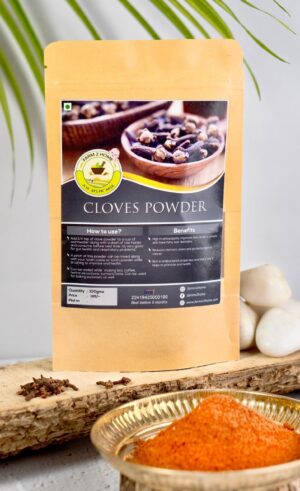
Clove powder is dried clove buds ground to a fine, dark brown spice. It is one of the most pungent spices in the Indian kitchen, with a warm, sweet, faintly peppery aroma. A quarter teaspoon is usually enough for a dish of four. It is used in garam masala, biryani, pulao, chai masala and baked goods.
In most Indian homes, cloves show up as whole buds floating in biryani rice or tempered into a pulao. Clove powder is the same spice in a form that mixes evenly into a masala, a batter or a marinade. If you have ever bitten into a whole clove in your rice and felt that sharp numbing burst on the tongue, you already know why the ground version is useful: it spreads the flavour instead of concentrating it in one unlucky mouthful.
Across India the spice carries different names. It is lavangam in Tamil and Malayalam, laung in Hindi, Punjabi and Urdu, lavanga in Kannada, Marathi and Bengali, and lavangalu in Telugu. The ground form is sold as clove powder or lavangam powder, and all of these refer to the same dried flower bud of the clove tree.
What clove powder tastes and smells like
Clove has one of the strongest aromas of any spice in the Indian rack. The smell is warm and sweet at first, close to cinnamon, then turns sharp and almost woody. On the tongue it is pungent and leaves a cooling, slightly numbing feeling that lingers.
That strength is the whole point and also the whole risk. Clove powder does not sit quietly in the background the way coriander powder does. Used in the right quantity it rounds out a masala and gives it depth. Used heavily it takes over and the dish starts tasting like a cough lozenge.
Grinding also changes how fast the flavour arrives. Whole buds release their aroma slowly over a long simmer. Powder releases everything in the first minute. So when a recipe calls for whole cloves and you are using powder instead, add it later in the cooking rather than at the tempering stage.
How much clove powder to use
Start smaller than you think. These are practical working amounts, not strict rules.
- Biryani or pulao for four: a quarter teaspoon of clove powder stirred into the masala, or mixed with the yoghurt marinade.
- Homemade garam masala: roughly one part clove to four parts cinnamon and six parts coriander, by volume. Clove is always a minority partner.
- Chai for two cups: the smallest pinch, along with cardamom, ginger and a little cinnamon.
- Meat curry or korma: a quarter to a half teaspoon for half a kilo, added with the other ground spices.
- Cakes, buns and halwa: an eighth of a teaspoon is plenty, paired with cinnamon and nutmeg.
- Rasam or sambar powder: a small pinch per batch. South Indian blends use clove sparingly compared to North Indian ones.
A good habit is to add half the clove, taste, then decide. You can always stir in more. You cannot take it out. Our cloves powder (lavangam powder) in a 100g pack at Rs 194.25 lasts a long while at these quantities, which is exactly how clove should be bought: a modest pack, finished while it is still fragrant.
Indian dishes that use clove powder
Clove is a core member of the warm spice group, so it turns up wherever Indian cooking wants richness rather than heat.
Rice dishes
Hyderabadi and Lucknowi biryani both lean on clove. In a dum biryani the powder goes into the marinade so it reaches the meat, while whole buds go into the rice water. Ghee rice and vegetable pulao use a smaller pinch.
Masala blends
Garam masala, chai masala, biryani masala, kolhapuri masala and Chettinad blends all include clove. If you grind your own blends at home, having clove already powdered saves you from the usual problem of hard buds refusing to break down in a mixie along with softer spices.
Gravies and curries
Korma, nihari, rogan josh, Mughlai paneer and Kerala stew all use clove in small amounts. It pairs naturally with onion, yoghurt, cashew paste and coconut milk.
Sweets and baking
Clove works well in gud ke chawal, carrot halwa, fruit cake, banana bread and spiced buns. It is also the standard partner for jaggery and dates.
Pickles and drinks
Many mango and lime pickle recipes include a pinch of clove powder. It also goes into kadha-style winter drinks and into mulled fruit punches during Christmas season in Kerala and Goa.
How to tell good quality clove powder
Clove is an expensive spice by weight, which makes it a frequent target for adulteration and for stale stock sitting in shop shelves. A few checks help.
- Colour: good clove powder is a deep reddish brown. Dull grey or pale tan usually means old stock or stems ground in along with buds.
- Aroma on opening: the smell should hit you immediately when you open the packet. If you have to lean in and sniff hard, the oil content has gone down.
- Feel: fresh clove powder is slightly oily and tends to clump a little. Bone dry, dusty powder that flows like flour is often old or padded with filler.
- Taste test: a few grains on the tongue should give that sharp numbing pungency within seconds.
- Packaging date: buy from a seller who packs in small batches rather than from an open sack. Ground spices lose aroma far faster than whole ones.
This is why we stock a 100g size. Buying half a kilo of clove powder at a time is false economy in an Indian kitchen, because the last two hundred grams will be flavourless by the time you reach them. You can order the 100g lavangam powder pack from Farm2Home and Farm2Home delivers across India, so restocking a small pack is simple.
Storing clove powder so it stays fragrant
Clove powder keeps its character for about six to eight months if stored properly, and noticeably longer in a cool climate than in coastal humidity.
Keep it in a small airtight steel or glass container rather than a large half empty one, because trapped air dulls the aroma. Store it away from the stove. The cabinet directly above a gas burner is the most common storage mistake in Indian kitchens, and heat drives off the aromatic oils fastest.
Use a dry spoon every time. Moisture from a wet spoon causes caking and encourages spoilage. During monsoon, many households keep ground spices in the refrigerator in a sealed jar, which works well as long as you let the jar come to room temperature before opening it to avoid condensation.
Clove powder versus whole cloves
Both have a place. Whole cloves are better when you want a slow, even infusion and plan to remove them later, as in biryani rice, rasam or a stock. Powder is better for marinades, dry rubs, masala blends, batters and anything that cooks quickly.
As a rough conversion, three whole cloves are close to a quarter teaspoon of clove powder. The powder tastes stronger per spoon because the surface area is larger, so err on the lower side when substituting.
Frequently asked questions
What is clove powder called in India?
It is called lavangam powder in Tamil and Malayalam, laung powder in Hindi, lavanga powder in Kannada, Marathi and Bengali, and lavangalu in Telugu. All refer to ground dried clove buds and can be used interchangeably in recipes.
How much clove powder should I add to biryani?
About a quarter teaspoon for a biryani serving four people. Mix it into the yoghurt marinade or the masala base rather than the rice water. Clove is strong, so adding more will dominate the cardamom and bay leaf notes.
Can I use clove powder instead of whole cloves?
Yes. Use roughly a quarter teaspoon of powder for every three whole cloves. Add the powder later in the cooking than you would add whole buds, since ground spice releases its aroma almost immediately and can turn bitter with long frying.
Why does my dish taste bitter after adding clove powder?
Usually too much powder, or clove added to very hot oil at the start and left to fry. Keep the quantity small and stir it in with the other ground spices once the onions and tomatoes have softened.
How long does clove powder stay good?
Around six to eight months in an airtight jar kept away from heat and moisture. It does not spoil quickly, but the aroma fades, and faded clove powder simply adds colour without flavour. Smell it before use and increase slightly if it has weakened.
What does clove powder cost and where can I buy it in India?
Farm2Home sells a 100g pack at Rs 194.25. You can buy clove powder online from Farm2Home with delivery across India, in a pack size small enough to finish while it is still aromatic.
Is clove powder the same as garam masala?
No. Clove is one ingredient inside garam masala, which also contains coriander, cumin, cinnamon, cardamom, black pepper and other spices. Clove powder on its own is far more pungent and should never be used in the same quantity as a garam masala blend.