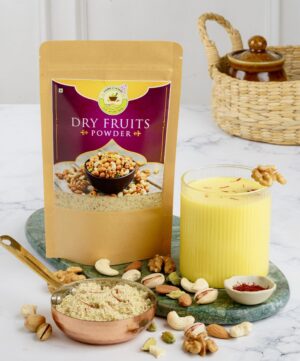
Dry fruits powder is a dry mix of roasted nuts and dried fruits ground to a fine, free flowing texture. Common ingredients are badam, kaju, pista, walnut, anjeer and dates. One or two teaspoons stir into warm milk, porridge, smoothies, halwa or batter, adding a nutty taste and a light natural sweetness without any cooking.
Most Indian kitchens already keep whole badam and kaju in a steel dabba. Grinding them into a powder simply makes them easier to use on a weekday morning. You do not have to soak, peel, chop or sit and chew anything. You scoop, stir and drink.
This guide covers what goes into a good dry fruits powder, how it should taste, how much to use in milk and porridge, how to store it in Indian humidity, and how long it realistically stays fresh. If you would rather not roast and grind at home, the Farm2Home dry fruits powder mix (100g) at Rs 367.50 is a ready ground blend made from whole nuts.
What is dry fruits powder made of?
A standard mixed nuts powder is built on four or five nuts and one or two dried fruits. The nuts give body and a roasted flavour. The dried fruits give sweetness and a slightly chewy, caramel note that survives grinding.
Typical ingredients in an Indian blend:
- Badam (almond) for the base. Mild, slightly sweet, and it grinds to a pale even powder.
- Kaju (cashew) for creaminess. Kaju is the reason a good powder thickens milk instead of sitting on top of it.
- Pista (pistachio) for colour and a salty green flavour in small quantity.
- Walnut (akhrot) for a deeper, slightly bitter edge. Too much walnut and the mix turns sharp.
- Anjeer (dried fig) and dates (khajur) for natural sweetness and tiny soft specks in the powder.
- Elaichi (cardamom) in many household versions, sometimes a pinch of kesar.
Some families add makhana, dried coconut or roasted magaz seeds. These are regional habits rather than fixed rules. What matters is that everything is properly dry before grinding, because a single moist ingredient will make the whole batch clump within a week.
What dry fruits powder should taste like
Fresh powder smells like roasted nuts the moment you open the jar. The taste is nutty first, then lightly sweet from the anjeer and dates, with a soft cardamom finish if it has been added.
If it tastes flat, chalky or faintly like oil paint, the nuts have gone rancid. That happens when the powder is kept too long, stored warm, or ground from nuts that were already old. Throw that batch out. There is no way to fix it.
How to use dry fruits powder in milk, porridge and sweets
The most common use across India is a glass of milk. Warm the milk, add one to two teaspoons of powder, stir hard for ten seconds, and drink it while it is still warm. The powder settles if the glass sits, so give it a second stir halfway.
Practical quantities, as a starting point:
- Milk: 1 to 2 teaspoons per 200ml glass, hot or cold.
- Porridge, ragi malt or oats: 1 teaspoon stirred in at the end, after switching off the flame.
- Curd or smoothie: 1 teaspoon, blended with banana or mango.
- Halwa, kheer and payasam: 2 tablespoons in the last few minutes of cooking.
- Chapati or dosa batter: 2 tablespoons per batch, mainly for flavour.
- Ice cream, kulfi or milkshake: sprinkled on top just before serving.
Add the powder after cooking wherever possible. Long boiling dulls the roasted aroma, which is the main thing you are paying for. In kheer and halwa, late addition keeps the nutty flavour distinct instead of letting it disappear into the ghee and sugar.
Does it need sugar?
Usually not much. The anjeer and dates already carry sweetness, so taste the milk before reaching for sugar. Many people add half a teaspoon of jaggery powder instead, which suits the nutty flavour better than white sugar.
For a plain unsweetened version, grind only nuts and skip the dried fruits. The powder will be looser, lighter in colour and will not clump as fast, since dried fruit is what holds moisture in a mix.
Dry fruits powder or whole dry fruits?
Both have a place. Whole badam and kaju are better for snacking, for a plate at a function, and for dishes where you want visible pieces and crunch.
Powder wins on convenience. It mixes into liquids, it goes into batter without changing the texture, and it works for anyone who finds whole nuts hard to chew, including elderly family members. It is also the easier format for a packed tiffin, where you just need one spoon in a flask of milk.
Cost wise, powder made from good whole nuts is not cheaper than the nuts themselves. If a powder is priced far below the market rate of badam and kaju, something cheap has been mixed in. Read the ingredient list and look for fillers like maida, rava, milk powder or added sugar near the top.
A simpler option: ready made laddoo
If you want the same ingredients in a form you can hand to someone directly, dry fruit laddoo does that job. Each piece is bound dry fruit, portioned and ready to eat, which saves you the stirring step entirely.
The Farm2Home dry fruits laddoo pack of 12 pieces at Rs 624.75 works well for lunch boxes, long train journeys and festival gifting. Many households keep both: the powder for daily milk, and the laddoo for travel and guests.
How to store dry fruits powder in Indian weather
Storage decides how long the powder lasts, and Indian humidity is unforgiving. Nuts hold oil, and oil turns stale when exposed to warmth, light and air.
- Keep it in a dry airtight glass or steel jar, filled as full as possible so there is less trapped air.
- Store it away from the stove and out of direct sunlight. A dark cupboard shelf is fine in winter.
- In Chennai, Mumbai, Kochi or any coastal city, keep the jar in the refrigerator through the hot and monsoon months.
- Use a dry spoon every single time. One wet spoon is the usual cause of a spoiled jar.
- Do not store it next to masala or hing. Nut powder picks up strong smells quickly.
Shelf life
Kept airtight in a cool cupboard, homemade dry fruits powder holds its flavour for about three to four weeks. In the refrigerator, you can expect roughly two to three months before the taste starts to dull. Packaged powder carries a printed best before date, and you should follow that date rather than any general rule.
Signs a batch is finished: a sour or paint like smell, visible clumping that does not break with a spoon, or any dampness on the surface. Discard it instead of trying to re-roast it.
Making dry fruits powder at home
It is a twenty minute job if you plan it. Dry roast each nut separately on a low flame, because badam, kaju, pista and walnut all brown at different speeds. Walnut is the quickest to catch.
Cool everything completely. Warm nuts release oil in the mixer and you end up with a paste rather than a powder. Then pulse in short bursts of two or three seconds, stopping to shake the jar, and sieve once at the end.
Chop anjeer and dates with scissors and add them in the last pulse only. If your dried fruit is soft, spread it in the sun for an hour or warm it briefly in a pan first. Grind in small batches of 200g or less so you can finish the jar while it is still fresh.
Buying dry fruits powder online in India
Check three things before you buy. First, the full ingredient list, with nuts named individually rather than hidden behind the words “dry fruits”. Second, the pack size against the price, so you can compare per 100g honestly. Third, the packaging, which should be sealed and opaque rather than a loose transparent pouch.
Farm2Home grinds its blend from whole nuts and delivers across India. Smaller 100g packs are the sensible way to start, since you finish them while the flavour is still good instead of nursing a large pouch for months. Both the mixed nuts powder and the laddoo pack ship nationwide.
Frequently asked questions about dry fruits powder
How much dry fruits powder should I add to a glass of milk?
One to two teaspoons per 200ml glass. Start with one, stir well, and taste before adding more. Any more than two teaspoons and the milk turns thick and grainy rather than smooth.
Can I give dry fruits powder to my child?
Many Indian families stir a small quantity into milk or porridge for children, usually starting with half a teaspoon. Since it contains nuts, introduce it slowly and check with your paediatrician first, particularly for toddlers or if there is any history of nut allergy in the family.
Does dry fruits powder need to be refrigerated?
Not compulsory in cool, dry weather, but it helps. In humid coastal cities and through the monsoon, refrigeration in an airtight jar noticeably extends how long the powder tastes fresh.
Can I add it to hot milk or will the flavour spoil?
Hot milk is fine. Stirring it into warm milk actually releases more aroma. What you should avoid is boiling the powder for several minutes, which flattens the roasted flavour.
Why has my dry fruits powder become sticky and lumpy?
Either moisture got in, or the mix has a high proportion of dates and anjeer. A wet spoon, a jar kept near the stove, or grinding nuts while they were still warm are the three usual reasons. Dates and anjeer naturally make a mix slightly sticky, so break lumps with a dry spoon before use.
What is the difference between dry fruits powder and badam mix?
Badam mix is mostly almond, often with sugar and cardamom added. Dry fruits powder uses several nuts together, such as badam, kaju, pista and walnut, along with dried fruits like anjeer and dates. The mixed version has a fuller, less one note flavour.
How long does one 100g pack last?
At one to two teaspoons a day for a single person, a 100g pack lasts around two to three weeks. For a family of four using it daily in milk, expect it to finish in under a week.