
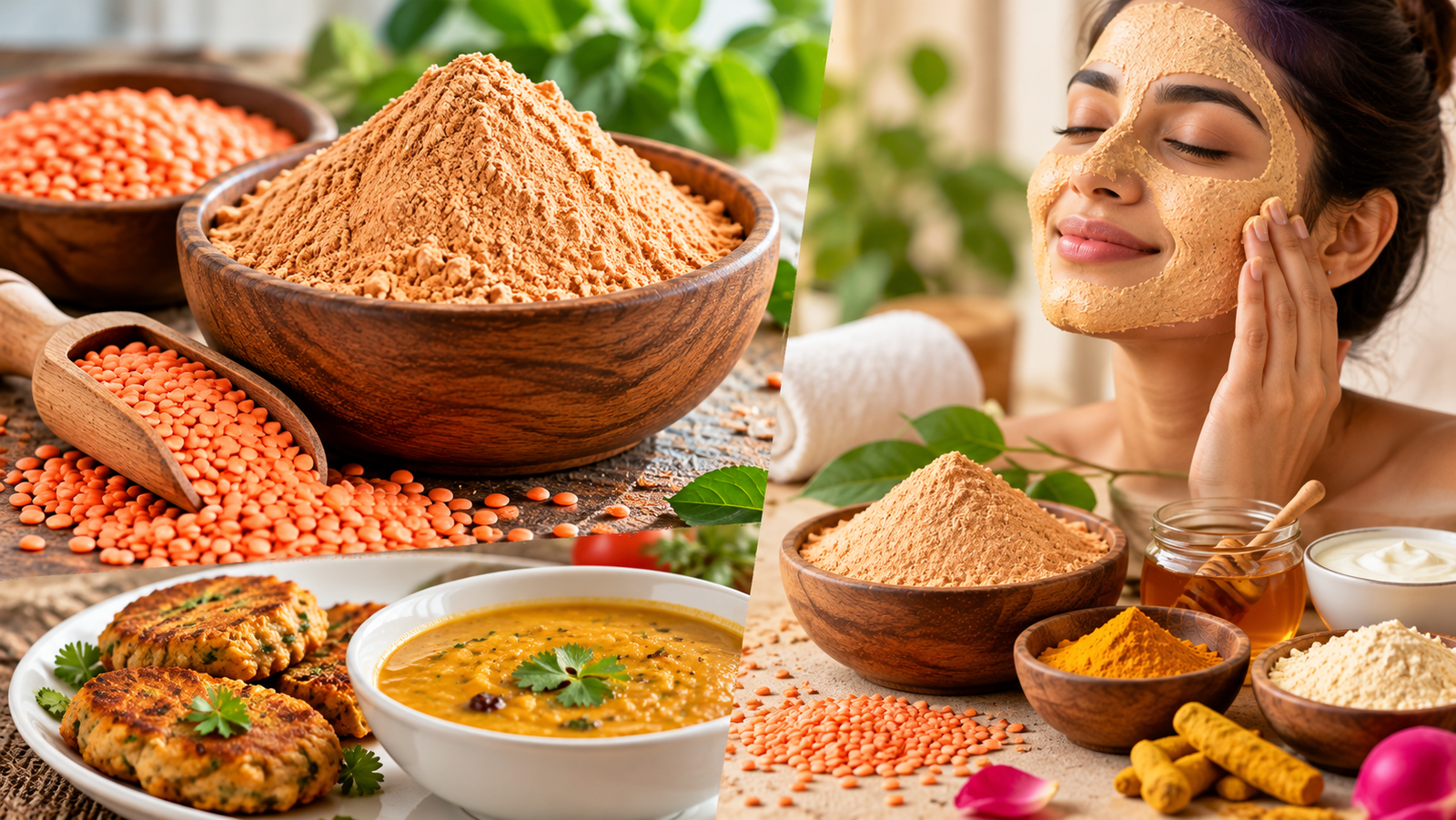
Masoor Dal Powder: What It Is and How Indian Homes Use It
Masoor dal powder is simply red lentil (masoor dal, mysore paruppu in Tamil) milled into a fine flour. Indian kitchens use it to thicken dals, soups and gravies and to add body to batters. Separately, it is one of the oldest ingredients in homemade ubtan, the traditional scrub paste made before weddings and festivals.
If you have only ever seen masoor dal as whole orange-pink lentils in a steel dabba, the powdered form can seem unfamiliar. It is the same lentil, nothing added, just ground down to a soft flour that behaves very differently in a pan and in the hand.
This guide covers both sides of it honestly: what it does in cooking, and what the traditional grooming use actually involves as a practice. Farm2Home stocks masoor dal powder in a 100g pack at Rs 168, milled from clean, sorted lentils and packed without any additives.
Masoor Dal, Mysore Paruppu, Red Lentil: Same Thing
Masoor dal is the split and husked form of the red lentil. In Tamil Nadu it is sold as mysore paruppu, in Kerala you will hear masoor parippu, and in English it is usually labelled red lentil or pink lentil. The colour ranges from pale salmon to deep orange depending on the crop and the season.
It is the fastest cooking of the common Indian dals. Whole masoor with the husk on takes longer and holds its shape; split masoor collapses into a soft mash in fifteen to twenty minutes without a pressure cooker, which is exactly why it became the weeknight dal in so many houses.
The powder takes that one step further. Because the particle size is already tiny, it hydrates almost instantly in hot liquid. There is no soaking, no waiting for the lentil to split open, no straining.
How fine is the powder
Good masoor dal powder sits somewhere between besan and rice flour in feel. It is soft and slightly powdery between the fingers, with a faint gritty edge if you press it, and it does not clump the way maida does. The colour in the packet is a muted pinkish beige rather than the bright orange of the whole dal.
Grind quality matters more than people expect. A coarse grind leaves visible specks that stay specks in a gravy and feel scratchy in a paste. A very fine, even mill disperses cleanly in both.
Cooking With Masoor Dal Powder
Use it as a lentil flour, not a spice. It carries a mild, slightly earthy lentil taste that sits in the background and does not fight with your tadka.
Quick dal in under fifteen minutes
Boil water with a pinch of salt and turmeric. Whisk the powder into a little cold water first to make a smooth slurry, then pour that into the boiling water while stirring. It thickens in about five minutes. Finish with a tadka of ghee, mustard seeds, jeera, dried red chilli, garlic and curry leaves, and squeeze in lemon at the end.
This is not a replacement for a slow-cooked dal with whole lentils, and it does not pretend to be. It is what you make at 9:30 pm when the cooker is already washed and put away.
Thickening gravies and kuzhambu
A spoon of the powder stirred into a thin sambar, kuzhambu or North Indian curry gives it body without the pasty mouthfeel you get from cornflour. Always slurry it in cold water or thin buttermilk before adding, otherwise it lumps.
It works well in vegetable kootu, in tomato-based gravies that have gone watery, and in Mughlai style curries where you want thickness but not more cream. Add it early enough to cook for three or four minutes so the raw flour taste goes away.
Soups and khichdi
For tomato shorba, mixed vegetable soup or a simple pepper rasam style soup, masoor dal powder is an easy thickener that also adds protein-rich lentil content to a thin broth. Two teaspoons for a litre is usually enough.
In khichdi, replacing a quarter of the dal with powder makes the final texture creamier and cuts a few minutes off the cook. Some families also use it in dal dhokli and in lentil based porridges for small children, cooked soft with a little ghee.
Batters, rotis and snacks
Adding a couple of tablespoons of masoor dal powder to dosa or adai batter is common practice, especially in adai where mixed dals are the whole point. It gives the dosa a slightly softer edge and a deeper colour.
You can also blend it into atta for rotis and theplas, roughly one part powder to five parts wheat flour. Beyond that ratio the dough starts feeling short and tears while rolling. It also works as a binder in vegetable cutlets, tikkis and masala vadai mixtures.
Storage
Keep it in an airtight steel or glass container away from the stove. Any lentil flour picks up moisture quickly in Indian humidity, especially during the monsoon, and once it cakes it is hard to disperse smoothly. A dry spoon every time is the whole trick.
The Traditional Ubtan and Scrub Use
In most parts of India, masoor dal powder has a second life entirely outside the kitchen. It is one of the usual ingredients in ubtan, the homemade paste that families prepare for the bride and groom in the days before a wedding, and for members of the household during festivals.
The practice is old and regional. In Maharashtra and Gujarat the pre-wedding haldi ceremony uses a similar paste. In Tamil and Telugu households, grandmothers mixed lentil flours with curd long before any packaged product existed. It was a cleansing and grooming ritual, done together, often outdoors, with everyone taking part.
To be clear about what this article is and is not saying: this is a description of a cultural practice and of how the powder behaves physically. Nothing here is a claim about any outcome on the body. Masoor dal powder is a food ingredient, and Farm2Home sells it as one.
How people traditionally mix it
- With plain curd, about one spoon of powder to one spoon of curd, worked into a thick paste that holds on the arm.
- With raw milk or malai, which gives a looser, smoother paste that spreads more easily.
- With plain water, the simplest version, usually mixed just before use so it does not dry out.
- With rose water, for a thinner mix with a lighter feel.
- With a pinch of haldi and a little besan, which is the classic festival ubtan combination.
The paste is left to sit for a couple of minutes so the flour takes up the liquid, then applied and rubbed off gently with the fingertips in small circles. People usually rinse with plain water. It is always made fresh, in the quantity needed, and never stored.
What it feels like
The dry powder feels soft and dusty. Mixed with curd it becomes a thick, slightly grainy paste that clings well. As it dries on the arms it tightens a little and starts to flake, which is the point at which people begin rubbing it off. Mixed with milk it stays softer and does not dry as fast.
Because the grind is fine, the feel is far less scratchy than a coarse rava or sugar scrub. That texture is exactly why it stayed in use for generations.
Buying Masoor Dal Powder in India
Look at three things: the grind, the colour and the smell. A fresh pack smells faintly of lentil and nothing else. A flat, stale or musty smell means it has been sitting too long, since any pulse flour loses its character with time.
Small packs make sense here. A 100g pack is the right size for a household that will use it across a few dals and one festival, rather than a kilo bag that sits open for months. Farm2Home’s 100g masoor dal powder pack is priced at Rs 168 and ships across India.
Frequently Asked Questions
What is masoor dal powder made of?
It is made of one thing: masoor dal, the split red lentil also called mysore paruppu in Tamil, milled into a fine flour. Farm2Home’s version has no additives, no preservatives and no added colour. It is just the lentil, cleaned, sorted and ground.
Can I use masoor dal powder instead of whole masoor dal in cooking?
For quick dals, soups and thickening, yes. Whisk it into cold water first to make a lump-free slurry, then add to boiling liquid. It will not give you the texture of a slow-cooked dal with intact lentils, so use whole masoor when the dish depends on that body.
How do I make masoor dal powder at home?
Dry roast split masoor dal lightly on low flame for three to four minutes, cool it fully, then grind in a dry mixer jar and sieve. Grind in short pulses so the jar does not heat up. Homemade powder is usually coarser than mill-ground, which is fine for dal but noticeable in a paste.
Why is masoor dal powder used in ubtan?
Because it was available in every kitchen, it grinds very fine, and mixed with curd or milk it forms a paste with a soft, slightly grainy texture that rubs off easily. It has been part of pre-wedding and festival ubtan customs across India for generations as a cleansing and grooming practice.
Is masoor dal powder the same as besan?
No. Besan is ground from chana dal, is pale yellow, and has a stronger, nuttier taste. Masoor dal powder comes from red lentil, is pinkish beige, and tastes milder. They are often used together in ubtan, and in cooking they are not interchangeable without changing the flavour.
How long does masoor dal powder stay good?
Kept in an airtight container in a dry, cool place away from the gas stove, it stays in good condition for several months. Check the pack date and use your nose. If it smells musty or has caked into hard lumps, it has taken up moisture and should be discarded.
Does Farm2Home deliver masoor dal powder across India?
Yes. Farm2Home ships pantry staples including masoor dal powder, milled from sorted red lentils, to addresses across India. Orders are packed in sealed pouches so the flour stays dry in transit.


