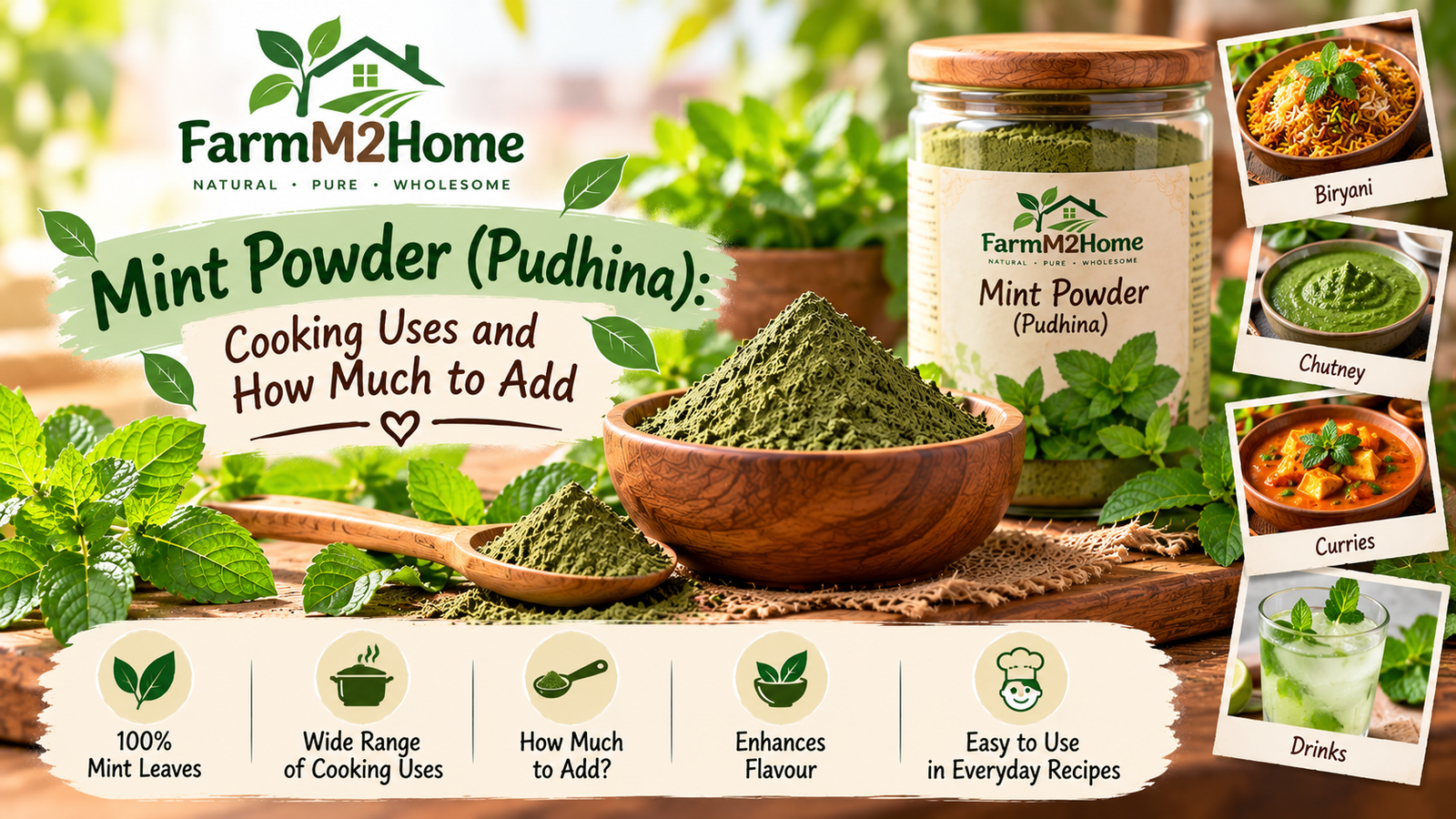
Mint powder is dried pudhina leaf ground to a fine green powder. It carries the cool, sharp aroma of fresh mint in a shelf-stable form, so you can add mint flavour to chutney, rice, raita, buttermilk, idli podi and marinades at any time of the year without a bunch of fresh leaves in the fridge.
In most Indian kitchens, fresh pudhina arrives in a bundle, half of it goes into a chutney, and the rest wilts in the vegetable tray within three days. Mint powder solves that specific problem. The leaves are dried and ground at their peak, and what you get is concentrated flavour that keeps for months in a closed jar.
Farm2Home stocks mint leaf powder (pudhina powder) in a 100g pack at Rs 195, and delivers across India. This guide covers what mint powder tastes like, how it behaves differently from fresh leaves, how much to use, which dishes suit it, and how to store it so it does not turn dull and hay-like.
What mint powder is and how it is made
Mint powder, called pudhina powder or pudina powder in most parts of India, is simply mint leaves with the water taken out. The leaves are separated from the thick stems, dried gently away from direct sun, and ground.
Drying temperature matters more than anything else. Mint holds its aroma in volatile oils sitting near the surface of the leaf, and harsh heat drives those off. Leaves dried slowly stay a deep grey-green and smell cool and grassy. Leaves dried too hot go brownish and smell like dry grass and nothing else.
That is the simplest way to judge a pack. Open it, hold it near your nose, and see whether the smell reads as mint or as generic dried leaf. Colour is the second clue. Good pudhina powder is green with a grey cast, never khaki.
How mint powder tastes compared to fresh pudhina
Fresh mint is bright, watery and slightly sweet, with a cooling finish that hits right at the front of the mouth. Dried mint powder loses the watery brightness and keeps the cooling edge, which comes through deeper and slower.
The flavour is also more concentrated by weight, because the water is gone. A spoon of powder carries the mint of a considerably larger volume of fresh leaves.
The practical difference in cooking is timing. Fresh mint is finished at the end, off the heat, or it goes black and bitter. Mint powder wants a little warmth and moisture to open up, so it goes in earlier, into hot oil, hot rice, batter or curd, and then gets a few minutes to bloom.
How much mint powder to use
Start low. Mint is assertive and a heavy hand turns a dish toothpaste-adjacent, which is not what anyone wants in biryani.
- Replacing fresh leaves: about one teaspoon of powder for a loosely packed quarter cup of fresh mint leaves. Adjust after tasting.
- Chutney: one to two teaspoons for a chutney made with half a cup of grated coconut or a handful of coriander.
- Rice and pulao: one teaspoon for two cups of raw rice, stirred into the tempering.
- Raita or curd rice: half a teaspoon for a cup of whisked curd, rested ten minutes before serving.
- Marinades: one teaspoon per half kilo of paneer, chicken or vegetables, along with ginger garlic paste and curd.
- Buttermilk: a quarter teaspoon per glass, with salt, green chilli and curry leaf.
The ten minute rest matters in anything cold. Powder needs time in liquid to rehydrate, and if you taste immediately you will think it has no flavour and add too much.
Indian dishes that suit mint powder
Pudhina chutney and podi
Mint powder makes a dry chutney powder that lasts weeks, which fresh chutney never will. Dry roast urad dal and red chilli, cool, grind with the mint powder, salt and a little tamarind, and you have a podi for idli and dosa.
If you would rather not build it from scratch, Farm2Home’s pudhina idli podi (mint leaf idli podi) in a 200g pack at Rs 236.25 is the same idea made up and ready. Mix it with gingelly oil and it goes with idli, dosa, uthappam and plain curd rice.
Rice dishes
Mint pulao, veg biryani and tomato rice all take mint powder well. Add it to the oil after the whole spices have crackled, let it sizzle for a few seconds, then add onions. The mint goes through the whole pot rather than sitting in green flecks.
For lemon rice and curd rice, stir the powder into the tempering at the very end so it does not scorch.
Raita, curd and buttermilk
Mint and curd are an old pairing across India, from boondi raita in the north to neer mor in Tamil Nadu. Powder works better than fresh leaves here because it disperses evenly and does not turn slimy by the second day.
Gravies, kebabs and tikkis
A teaspoon of pudhina powder in a hariyali gravy, a seekh kebab mix or an aloo tikki stuffing adds a cool note that cuts through heavier masala. It also works in besan batter for pakora.
Chaat, snacks and sprinkles
Mix mint powder with chaat masala and black salt, and you have a sprinkle for fruit, cut onion, papad, roasted makhana and fries.
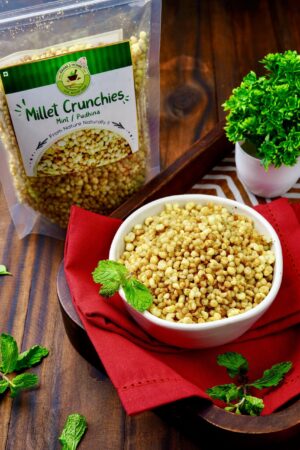
For a ready snack along the same lines, the mint pudhina millet crunchies, 100g for Rs 115.50, carry the same flavour in a millet-based crunchy form that works for tea time or a lunchbox.
Storing mint powder so it stays green
Aroma is the whole point of this ingredient, and three things take it away: air, light and heat.
- Transfer to a small airtight glass or steel jar. A half-empty large jar holds a lot of air.
- Keep it in a dark cupboard, not on the shelf above the stove.
- Use a dry spoon every time. Steam from a wet spoon makes the powder clump.
- Do not keep it open next to strongly flavoured powders, because mint picks up smells.
Stored this way, a 100g pack of pudhina powder from Farm2Home holds good aroma for several months. It does not spoil after that, it simply fades, and you will find yourself using more for the same effect.
Buying mint powder online in India
Check three things before you buy. First, whether the pack says mint leaf powder rather than a mint-flavoured blend with added starch or salt. Second, the pack size, since 100g of mint powder goes a long way and a very large pack will fade before you finish it. Third, the colour in the product photograph.
Farm2Home grinds in small batches and ships across India, so what reaches you has not been sitting in a warehouse for a year.
Frequently asked questions about mint powder
Can I use mint powder instead of fresh mint leaves?
Yes, in almost everything except garnish. Use about one teaspoon of powder for a quarter cup of fresh leaves, and add it earlier in the cooking so it has time in heat or liquid. For a final garnish on biryani or chaat, fresh leaves still look better.
What is the difference between pudhina powder and mint chutney powder?
Pudhina powder is only dried ground mint leaves, with nothing else. Mint chutney powder or idli podi is a blend: mint plus dals, red chilli, salt and often tamarind or asafoetida. The plain powder is an ingredient, the podi is a finished mix.
Does mint powder taste bitter?
Good mint powder is not bitter. Bitterness usually comes from stems ground along with the leaves, or from leaves dried at too high a heat. It can also appear if you add the powder to very hot oil and let it burn.
How much mint powder goes into biryani?
About one teaspoon for two cups of raw rice, added with the onions or into the marinade rather than at the end. If you are also using fresh leaves, halve the powder.
How long does mint powder keep?
Several months in an airtight jar away from light and heat. It stays usable longer than that, but the aroma drops off, which is the only reason to buy it.
Can I make mint powder at home?
Yes. Pluck the leaves off the stems, wash and pat dry, spread on a plate in a shaded airy spot for two to three days until the leaves crumble, then grind in short bursts and sieve. Skip the microwave and direct midday sun, both of which cost you the aroma.
Is mint powder the same as dried mint flakes?
Same leaf, different grind. Flakes are coarse and stay visible in the dish, which suits salads and dips. Powder dissolves into gravies, batters and curd, which is what you want for Indian cooking.