When exploring traditional herbal hair-care ingredients, you may come across names such as Avuri Powder, Indigo Powder, Indigo Leaf Powder, and Neel Powder. Because these names are often used for similar products, many people wonder whether Avuri Powder and Indigo Powder are actually the same.
In many Indian herbal products, Avuri refers to Indigofera tinctoria, the plant commonly known as true indigo. Products described as Indigo Powder for hair are also commonly made from the dried leaves of Indigofera tinctoria.
However, the answer depends on exactly what the product contains. The words “indigo powder” can sometimes be used for different forms of indigo, so checking the botanical name and ingredient list is important.
What Is Avuri Powder?
Avuri Powder is traditionally made from the dried leaves of Indigofera tinctoria. In Tamil Nadu and other parts of India, Avuri is a familiar name associated with the indigo plant. Some herbal products specifically identify their Avuri Powder as dried Indigofera tinctoria leaves.
The plant has a long history of use as a source of natural indigo colouring. Its leaves can be processed into a fine powder for traditional applications, including herbal hair-colouring routines.
The appearance of the powder can vary depending on processing, grinding and storage.
What Is Indigo Powder?
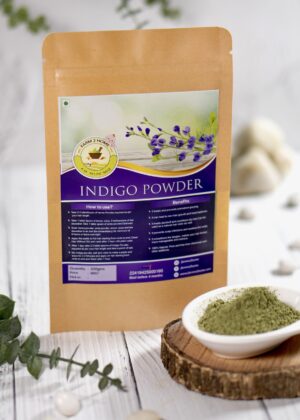
The term Indigo Powder generally refers to powder made from the indigo plant. For natural hair-colouring products, manufacturers commonly use dried leaves of Indigofera tinctoria.
When used in traditional herbal hair-colouring routines, indigo is often paired with henna. Henna can provide a warm base colour, while indigo can contribute darker brown to black tones depending on the application method, hair characteristics and formulation.
This is why you may see products marketed as “Natural Indigo Powder,” “Indigo Leaf Powder,” or “Indigofera tinctoria Powder.”
So, Are Avuri Powder and Indigo Powder the Same?
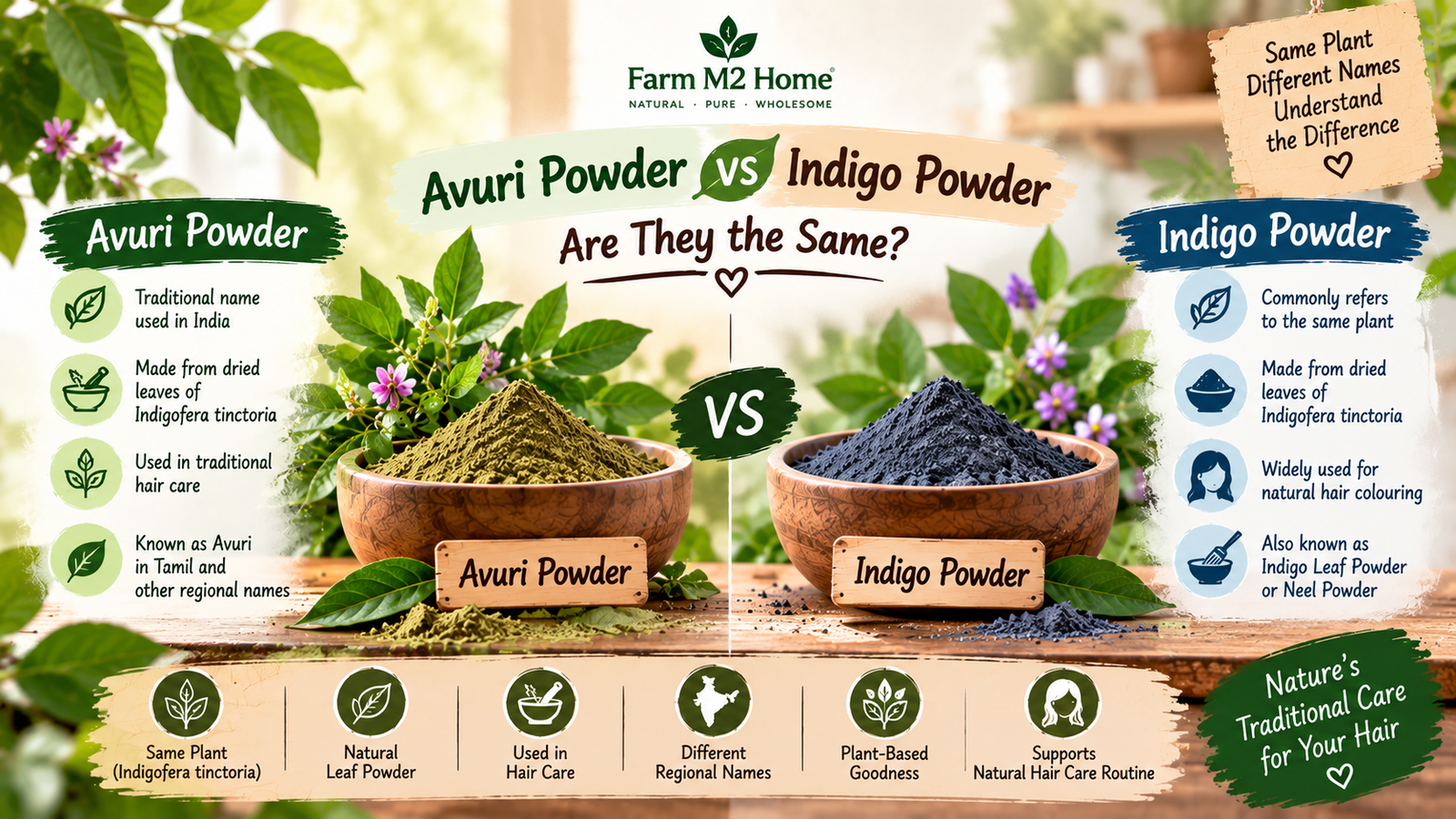
They can be the same when both products are made from Indigofera tinctoria leaves.
For example:
Avuri Powder → Indigofera tinctoria leaf powder
Indigo Leaf Powder → Indigofera tinctoria leaf powder
In this situation, the main difference may simply be the name used by the seller or the regional name of the plant.
However, not every product labelled “indigo powder” should automatically be assumed to be identical.
The product could be intended for hair, textile dyeing or another purpose. Therefore, always check the label.
What Should You Check Before Buying?
If you are comparing Avuri Powder and Indigo Powder, look at these details.
1. Botanical Name
Look for:
Indigofera tinctoria
This is one of the clearest ways to determine whether the powder comes from the true indigo plant.
2. Ingredient List
Check whether the product contains only indigo leaf powder or whether other ingredients have been added.
Some commercial products may contain additional herbs or ingredients depending on their intended use.
3. Intended Use
A product designed for hair colouring should be clearly labelled for cosmetic or hair-care use.
Do not assume that a powder sold for textile dyeing or another application is suitable for use on hair.
4. Product Instructions
Different products may have different preparation methods.
Always follow the manufacturer’s instructions rather than using the same preparation method for every indigo product.
How Is Indigo Traditionally Used for Hair?
One common traditional approach involves using henna first and indigo afterwards.
Henna provides a warm reddish or copper-toned base, while indigo can create deeper brown or black shades when used as the second step. The final result can vary according to the starting hair colour, amount of grey hair, application technique and processing time.
Some products are also marketed for use as indigo alone, but the resulting shade may not be the same as a two-step henna-and-indigo process.
Because results vary, a small strand test can be useful before applying a new hair-colouring product to the whole head.
🌿 Avuri Powder in Traditional Indian Hair Care
Avuri has a strong connection with traditional Indian herbal practices.
The plant Indigofera tinctoria has been valued historically for its natural blue pigment, and dried leaf powder is now commonly found in natural hair-colouring products.
This makes Avuri Powder interesting for people who prefer plant-based ingredients as part of their personal-care routines.
It is important, however, to separate traditional use from medical claims. Indigo or Avuri Powder should primarily be discussed as a traditional colouring ingredient rather than as a proven treatment for scalp or hair disorders.
🌱 Avuri Powder vs Indigo Powder: Quick Comparison
| Feature | Avuri Powder | Indigo Powder |
|---|---|---|
| Common botanical source | Indigofera tinctoria | Often Indigofera tinctoria |
| Plant part | Usually dried leaves | Usually dried leaves for hair products |
| Common traditional use | Natural colouring and herbal applications | Natural hair colouring |
| Regional name | Avuri | Indigo / Indigo Leaf |
| Hair use | Depends on product label | Common in herbal hair colouring |
| Important check | Botanical name and ingredients | Botanical name and intended use |
Choose the Right Product
The name alone is not enough.
A good buying habit is to check the botanical name, ingredient list, intended use, manufacturer information and directions.
If the package identifies Indigofera tinctoria leaf powder and is specifically intended for hair use, it is much easier to understand what you are purchasing.
If you have sensitive skin or scalp, consider doing a patch test according to the product instructions before full application.
Farm M2 Home: Traditional Ingredients for Modern Routines
At Farm M2 Home, traditional plant ingredients are connected with simple, modern routines.
When comparing Avuri Powder vs Indigo Powder, the most important point is that Avuri and Indigo can refer to the same plant when the product is made from Indigofera tinctoria leaves.
Still, product labels matter. Two products with similar names can have different ingredients, processing methods or intended uses.
So, before choosing a powder, look beyond the name and check the botanical name and ingredient list.
Traditional names may differ, but understanding the ingredient helps you make a more informed choice for your hair-care routine.
🌿 Farm M2 Home
Traditional Ingredients • Natural Inspiration • Everyday Care