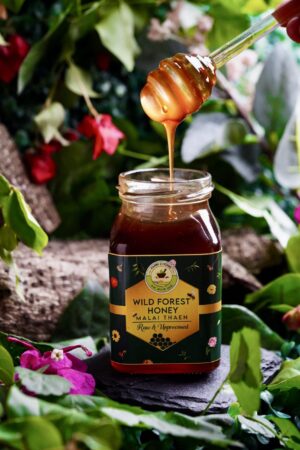
Forest honey is honey gathered from wild bee colonies living in forest trees and rock faces, not from boxed apiary hives. Because the bees forage on whatever the forest is flowering that season, each batch differs in colour, aroma and thickness. Raw forest honey is strained and bottled without heating, so it stays thick and crystallises over time.
In Tamil it is called malai thaen, which simply means hill honey. In Hindi and across north India people ask for jungle shahad. Both names point at the same thing: honey that came out of a forest, collected by hand, not produced on a farm with managed hives and sugar feeding.
That difference is the whole story of this product, and it explains most of the questions buyers have. Why is one bottle dark and the next one golden? Why does it set hard in the jar? Why does it taste slightly different from the clear, runny honey sold in supermarkets? All of it comes back to where the honey came from and what was not done to it afterwards.
What forest honey actually is
Wild bees in Indian forests build open combs, often high up on tall trees or under rock ledges. Honey gatherers climb to these combs, take a portion of the comb, and leave the colony to rebuild. The comb is then pressed or allowed to drip, and the honey is strained through cloth to remove wax and bits of comb.
Nothing is added. The honey is not blended with syrup, not filtered under pressure, and not heated to keep it permanently liquid. That is what “raw and unprocessed” means on a label, and it is why the wild forest honey or malai thaen sold by Farm2Home at Rs 414.75 looks and behaves differently from factory honey.
Apiary honey, by contrast, comes from wooden box hives placed deliberately near a single crop: mustard, litchi, eucalyptus, sunflower. The beekeeper controls the floral source, so the honey is consistent bottle to bottle. Consistency is a real advantage for a packaged product. It just is not what forest honey is.
Wild gathered against farmed
- Floral source: forest honey draws on dozens of wild flowering trees, shrubs and creepers at once. Box honey usually comes from one crop in bloom.
- Season: forest harvests follow the forest. A spring comb and a post monsoon comb from the same area can taste noticeably different.
- Consistency: farmed honey is uniform by design. Forest honey varies, and the variation is a sign it was not standardised.
- Handling: raw forest honey is strained and bottled. Commercial honey is often heated and fine filtered so it pours clear and never sets.
Colour, aroma and taste: why no two batches match
Expect anything from pale amber to deep brown, almost molasses coloured. Dark honey generally comes from stronger flowering sources and tastes more robust, with woody or slightly bitter edges. Lighter batches tend to be more floral and simply sweeter.
The aroma is usually stronger than that of supermarket honey. Raw honey keeps its volatile floral notes because it has not been heated, and those notes are the first thing you notice when you open the jar.
Texture varies too. Some batches are thick and slow pouring from day one. Others start thinner, particularly if harvested in a humid stretch, and thicken later. A thin batch is not watered down honey; moisture content in wild comb genuinely varies.
Taste is rarely one note. Many people describe a sweetness that arrives with a faint tang behind it, sometimes a hint of smoke or resin from forest flora. If you have only ever had uniform golden honey, the first spoon of forest honey registers as more complicated.
Why forest honey crystallises
Honey is mostly two sugars, glucose and fructose, held in very little water. Glucose does not like staying dissolved, so over weeks or months it separates out as fine crystals. The honey turns cloudy, then grainy, then sets into a spreadable or firm mass.
This is normal. Crystallisation is a physical change in the sugars, not spoilage, and not proof of adulteration. In fact heavily processed honey resists setting precisely because heating and fine filtering remove the tiny particles that crystals form around.
Cool weather speeds it up. A jar kept in an air conditioned room or a Bengaluru winter will set faster than one sitting in a Chennai kitchen. Honey high in glucose sets quickly; higher fructose batches may stay runny for a long time.
To loosen set honey, stand the closed jar in a bowl of warm, not boiling, water for ten to fifteen minutes and stir. Avoid the microwave and avoid direct flame. Strong heat changes the aroma you paid for, and repeated reheating flattens the flavour permanently.
How to use forest honey in an Indian kitchen
The simplest use is a spoon stirred into warm milk at night. Let the milk cool slightly first so the honey keeps its aroma rather than cooking off.
Drizzle it over hot dosa, especially set dosa or ragi dosa, where the darker honey works against the fermented tang. On chapati with a little ghee it makes a quick breakfast for children who refuse anything else.
Use it in panakam in place of some of the jaggery, with lemon, dry ginger and a pinch of cardamom. It dissolves readily in cold water and gives the drink a rounder sweetness. Honey with lemon in plain water is a standard morning glass in many Indian households.
It also works where you would otherwise use sugar syrup: brushed on hot appam, folded into curd with chopped fruit, poured over vanilla ice cream, or mixed into a sesame and peanut chikki style mixture. In sweets, remember that honey browns faster than sugar, so add it late or off the heat.
For a plain comparison at home, taste a spoon of the raw unprocessed malai thaen from Farm2Home beside whatever bottled honey is already in your kitchen. The difference in aroma usually settles the question faster than any label does.
Storage, in short
- Keep it in a tightly closed glass or food grade jar, away from sunlight and the stove.
- Do not refrigerate. Cold only hurries crystallisation along.
- Use a dry spoon. Water carried in on a wet spoon is the one thing that can genuinely start fermentation.
- Honey keeps for a long time at room temperature. Setting, cloudiness and slight darkening with age are all expected.
Buying forest honey without getting caught out
Price is the first signal. Wild comb is collected in small quantities by hand, so forest honey costs more per kilogram than box honey, and a very cheap bottle labelled wild is worth a second look.
Ignore the old home tests. Dropping honey in water, burning a matchstick dipped in it, or watching whether a drop spreads on paper tell you almost nothing reliable, because moisture content alone changes all three outcomes. Thickness is not proof of purity either.
What is more useful is knowing whether the honey was heated, whether anything was blended into it, and whether the seller describes the source honestly, including the fact that batches vary. A seller who promises every bottle will look identical is describing a processed product.
Farm2Home delivers across India, so forest honey from south Indian hill areas reaches homes well outside the region it was gathered in. You can order the wild forest honey at Rs 414.75 along with the rest of your grocery order rather than hunting for it locally.
Forest honey frequently asked questions
Is forest honey the same as malai thaen?
Yes. Malai thaen is the Tamil name for hill or forest honey, and jungle shahad is the common Hindi term. All three describe honey collected from wild bee colonies in forest areas rather than from managed box hives.
Why has my forest honey turned thick and grainy?
That is crystallisation. The glucose in honey separates out as fine crystals over time, especially in cooler weather. The honey is still perfectly good. Stand the closed jar in warm water for ten to fifteen minutes and stir to bring it back to a pourable state.
Why does the colour change between bottles?
Because wild bees forage on whatever the forest has in flower, and that changes with the season and the area. Dark batches usually taste stronger and more woody, lighter batches more floral. Variation is expected in wild gathered honey.
Can I add forest honey to hot tea or coffee?
You can, but let the drink cool for a minute first. Boiling liquid drives off the floral aroma that makes raw honey worth buying. The same applies to cooking: add honey towards the end rather than at a rolling boil.
Is raw honey safe for small children?
Honey of any kind, raw or processed, is not given to infants under one year of age. This is standard advice worldwide. For older children it is used like any other sweetener, in ordinary amounts.
How long does forest honey last?
Kept dry, closed and at room temperature, honey lasts a very long time. It may darken, thicken or set along the way. The main thing to avoid is moisture getting into the jar, so always use a dry spoon.
What does forest honey cost at Farm2Home?
Wild forest honey, labelled malai thaen and sold raw and unprocessed, is priced at Rs 414.75. Farm2Home ships across India, and it can be added to a regular grocery order.