
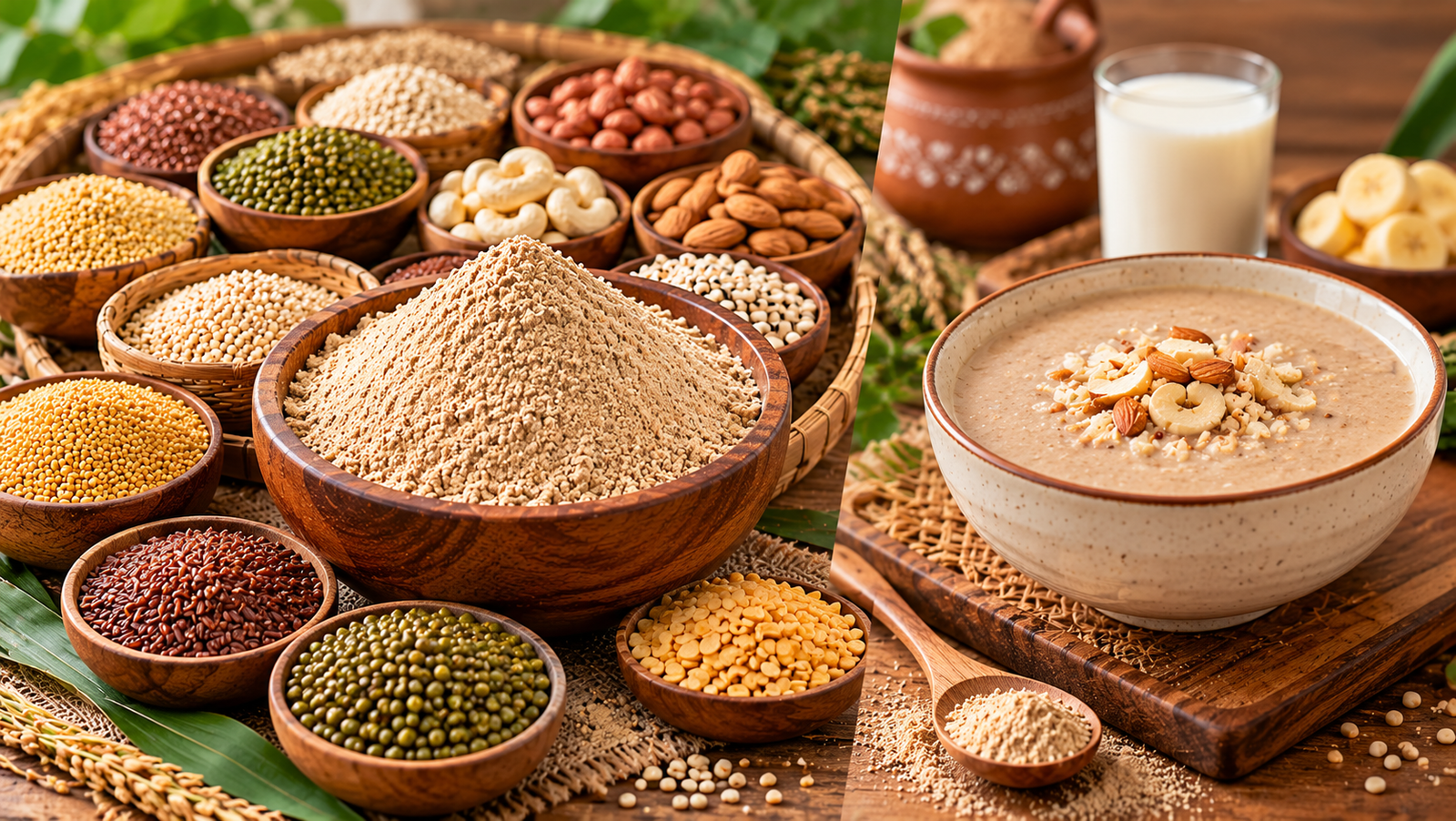
Sathu maavu is a traditional South Indian multigrain flour mix, made by roasting or sprouting grains, millets, pulses, nuts and seeds, then grinding them into a fine powder. In Tamil Nadu it is cooked with water or milk into a smooth porridge called sathu maavu kanji, served warm to children and adults alike.
If you have been searching for sathu maavu because someone in your family recommended it, this guide covers what actually goes into the mix, how it tastes, how to cook it without lumps, how to store it in Indian weather, and what to look for before you buy. The name itself is Tamil: sathu means essence or substance, and maavu means flour.
What goes into a real sathu maavu mix
There is no single fixed recipe. Every household and every brand has its own proportion, and that is part of why the flavour varies so much from one packet to the next. What stays constant is the structure: cereals and millets form the base, pulses add body, and nuts and seeds carry the aroma.
A well made mix usually draws from these groups:
- Millets: ragi (finger millet, nachni), kambu (pearl millet, bajra), thinai (foxtail millet), varagu (kodo millet), samai (little millet)
- Cereals: red rice or hand pounded rice, wheat (godhumai), maize (makka cholam)
- Pulses: green gram (pasi payaru, moong), bengal gram (kadalai paruppu, chana dal), horse gram (kollu), soya
- Nuts and seeds: almonds (badam), cashew (mundiri), groundnut (verkadalai), sesame (ellu, til), flax (ali vidai)
- Aromatics: cardamom (elakkai), dry ginger (sukku), sometimes a little jeera
The word that matters most on a label is sprouted. Sprouting means the grains and pulses are soaked until they germinate, then dried and roasted before grinding. It takes days longer than simply roasting raw grain, and it changes the taste: sprouted mixes are noticeably sweeter and less raw tasting, with a malty note similar to ragi malt. The Farm2Home sprouted multigrain sathumaavu porridge mix at Rs 288.75 is made this way, which is why it cooks down smooth rather than pasty.
What sathu maavu tastes like
Expect an earthy, nutty, lightly sweet flavour with a toasted aroma that comes through strongest in the first minute of cooking. Ragi and kambu give it a mild mineral edge. The nuts and sesame round it off. Cardamom and sukku, if present, sit in the background.
Texture depends entirely on how you cook it. Thin it down and it drinks like a milkshake. Cook it thick and it sets almost like a halwa as it cools. Most families in Tamil Nadu keep it somewhere in between, pourable but coating the spoon.
How to cook sathu maavu kanji without lumps
Lumps are the single most common complaint, and they come from adding hot liquid to dry flour. The fix is simple.
- Take two heaped tablespoons of the flour in a bowl.
- Add a quarter cup of room temperature water and whisk it into a slurry with no dry pockets left.
- Pour the slurry into a pan with one cup of water or milk and set it on low to medium flame.
- Stir continuously for five to seven minutes until it thickens and loses the raw flour smell.
- Switch off, then add jaggery (vellam), palm jaggery (karupatti) or sugar. Adding jaggery before the flour is cooked can make milk split.
For a savoury version, skip the sweetener and finish with a pinch of salt, a spoon of curd or buttermilk (moru), and a tempering of mustard seeds, curry leaves and shallots in a little gingelly oil. This savoury style is common in the Kongu belt around Coimbatore and Erode during summer.
Other ways Indian kitchens use it
Beyond kanji, the flour works as a partial substitute in everyday cooking. Replace a quarter of the atta in your chapati or paratha dough. Add two spoons to idli or dosa batter. Mix it into pancake batter, into kozhukattai filling, or into a banana and milk shake for a quick breakfast. It also blends well into ragi java and into porridge for elders who prefer soft food.
Sathu maavu beyond the porridge: cookies and laddoo
Porridge is not always practical. Children going to school, office tiffin boxes and travel days all call for something you can eat with your hands.
For school snack boxes and tea time, the sprouted multigrain sathu maavu cookies priced at Rs 199.50 use the same grain base in a baked, crisp form. They are mildly sweet rather than sugary, with the millet flavour still recognisable.
The other format is laddoo. A 20 ingredient sprouted multigrain sathumaavu laddoo pack of 12 pieces at Rs 498.75 works out to a fixed portion per piece, which is convenient when you are packing one for a lunch box or handing one over after school. Laddoos also hold up better than cookies in a bag.
How to buy and store sathu maavu
Three things separate a good packet from a mediocre one.
Ingredient count and clarity. A proper label lists every grain by name. Vague descriptions like “multigrain flour” without a breakup usually mean a wheat heavy filler mix.
Sprouted versus plain roasted. Sprouted mixes cost more and taste better. If the packet does not say sprouted, assume it is not.
Grind date and freshness. Because of the nuts and seeds, this flour carries natural oils and will turn stale if it sits too long. Buy smaller quantities more often rather than a large pack that lasts six months.
For storage in Indian humidity, transfer the flour to a dry airtight steel or glass jar as soon as it arrives. Keep it away from the stove and the sink. Always use a bone dry spoon, since a single drop of water invites clumping. During the monsoon, or in coastal cities like Chennai, Kochi and Mumbai, the fridge is the safer place for it. Let the jar come to room temperature before opening so condensation does not form inside.
Sathu maavu prices and delivery across India
Packaged sprouted mixes sit well above loose flour mill powder, and that gap reflects the soaking, drying and roasting work plus the cost of almonds and cashew. Farm2Home delivers across India, so you can order the sathumaavu porridge mix along with the sprouted multigrain laddoo box in one go, whether you are in Chennai, Bengaluru, Hyderabad, Delhi or a smaller town. If you are ordering for a household with school going children, adding a pack of the sprouted multigrain cookies alongside the flour covers both the morning kanji and the evening snack.
Frequently asked questions about sathu maavu
What is sathu maavu called in other Indian languages?
In Tamil it is sathu maavu or sathu mavu. Telugu speakers call a similar mix sattu pindi, and in Kannada it is sattu hittu. Health mix and multigrain health mix are the common English shop labels. North Indian sattu is different: it is usually roasted bengal gram alone, not a multigrain blend.
At what age can children start having sathu maavu?
Most Tamil families introduce a simple version after six months of age and the fuller nut based mix later, since nuts and wheat are usually added gradually. Mixes containing almonds, cashew, wheat or soya are generally kept for older children. Check with your paediatrician for your own child before starting.
Does sathu maavu contain gluten?
Most mixes include wheat, so they are not gluten free. Read the ingredient list on the pack if this matters for your household.
How much sathu maavu should I use per serving?
Two heaped tablespoons per person with roughly one cup of water or milk gives a standard bowl of kanji. Use less liquid for a thicker consistency and more for a drinkable one.
Can adults have sathu maavu or is it only for children?
Adults have it regularly across Tamil Nadu, usually as a morning kanji or an evening drink in place of tea or coffee. The savoury buttermilk version is popular with adults in particular, and it is also a common breakfast for elders because it is soft and easy to chew.
How long does an opened packet stay fresh?
Kept in a dry airtight jar away from heat, an opened packet is usually good for about two to three months. Refrigerated, it holds longer. If the aroma turns flat or the flour smells sour from the nut oils, discard it.
Is sathu maavu the same as ragi malt?
No. Ragi malt is made from finger millet alone, so it tastes distinctly of ragi. Sathu maavu blends many millets, pulses, nuts and seeds, which gives it a rounder, nuttier flavour and a lighter colour than ragi malt.


