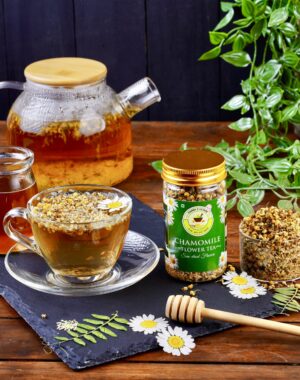
The chamomile flower is the small, daisy-like bloom that gets dried whole and dropped into hot water to make one of the most recognisable floral teas in the world. In India it has gone from a specialty import to a regular item in home kitchens, and most people now buy it as loose dried flower heads rather than dust-filled teabags. This guide covers what the flower actually is, how it tastes, how to brew it properly, and how to store it so it keeps its aroma.
A chamomile flower is the dried bloom of a small flowering plant in the daisy family. Each head has a domed yellow centre ringed by short white petals, and measures about the size of a shirt button. Dried whole and steeped in hot water, it produces a pale golden brew with an apple-like aroma and a light, honeyed floral taste.
What the chamomile flower looks and smells like
Pick up a spoonful of good dried chamomile and the first thing you notice is that the flowers are still flowers. You can see individual white petals, some folded back, some broken off, and the firm yellow cone at the centre of each head. That yellow cone holds most of the aroma, which is why whole-flower chamomile smells so much stronger than the powdered version sold in paper bags.
The smell is the giveaway. Fresh dried chamomile has a clear scent of apple skin and dried hay, with a faint sweetness behind it. The Greek root of the name translates roughly to earth-apple, and once you have smelled a good batch you understand why. Older or badly stored flowers lose that apple note first and start smelling flat and dusty.
Colour matters too. Petals should be cream to off-white and the centres a warm mustard yellow. Grey, brown or uniformly beige flowers have usually been sitting in heat or light for too long. Our chamomile flower tea in a 25g pack is sold as whole heads for exactly this reason, so you can judge the quality by eye before it ever reaches the kettle.
How chamomile flower tea tastes
Brewed properly, chamomile is light. The liquid is pale gold, almost straw coloured, nothing like the deep brown of a strong Assam. The flavour is floral and faintly sweet, closest to the inside of a ripe apple, with a thin honey note on the finish and a slight dryness that stops it being cloying.
It has no tannin bite because chamomile is not a true tea leaf at all. There is nothing in the cup to turn harsh and astringent the way black tea does when it sits. That also means it carries no caffeine, so people in India often reach for it in the evening when a second filter coffee or a strong chai would be too much.
The common complaint is bitterness, and it is almost always a brewing problem rather than a quality problem. Push chamomile too hard and the yellow centres release a resinous, slightly woody edge that flattens the apple character. Get the proportion and timing right and bitterness simply does not appear.
How many chamomile flowers per cup
For a standard 200ml cup, use about one level teaspoon of dried flower heads, which usually works out to eight to twelve whole blooms depending on their size. Whole flowers are bulky and light, so measure by volume and then adjust once you know how strong you like it.
For a 500ml teapot shared between two people, two to two and a half teaspoons is right. Err on the lower side the first time. Chamomile is easy to strengthen by adding a few more flowers to the next pot, but a brew that has gone bitter cannot be rescued.
- One cup, 200ml: 1 teaspoon of flowers
- Two cups, 400ml to 500ml: 2 to 2.5 teaspoons
- Large pot for guests, 1 litre: 4 to 5 teaspoons
Steeping time and why over-steeping turns it bitter
Pour water just off the boil, around 95 degrees Celsius, over the flowers and leave them for four to five minutes. Three minutes gives a very delicate cup. Beyond six or seven minutes the apple aroma starts giving way to a flat, slightly harsh taste that sits at the back of the tongue.
The reason is simple. The aromatic compounds in the flower heads come out fast, within the first few minutes, while the heavier bitter compounds in the yellow centres come out slowly and keep coming out as long as the flowers sit in hot water. A short steep collects the good part and leaves most of the rest behind.
So strain the flowers out when the time is up instead of letting them sit in the cup. If you use an infuser basket, lift it out. If you brewed loose, pour the whole lot through a small kitchen strainer into a second cup. This one habit makes more difference to the taste than anything else.
Can you re-steep chamomile flowers?
You can get a second, much lighter cup from the same flowers if you brew it immediately after the first. Give the second round six or seven minutes since most of the aroma has already gone. A third steep is mostly coloured water and not worth the effort.
Hot, iced, and what to add
Hot is the default and the best way to meet the flower for the first time, with nothing added, so you can taste what it actually is. Once you know the plain version, additions make sense.
A small spoon of honey works better than sugar because the flower already has a honeyed note and the two run together. Add it once the cup has cooled slightly rather than into boiling liquid. Jaggery also works and gives a darker, more caramel edge, though it does cover the delicate floral notes.
A thin slice of lemon or a squeeze of juice brightens the cup and makes the apple character more obvious. Go easy, because too much acid will dominate completely. A couple of fresh mint leaves added at the end of the steep is another combination worth trying, particularly in the hotter months.
For iced chamomile, brew at double strength, two teaspoons of flowers per cup of water, steep five minutes, strain, then pour over a full glass of ice. The dilution from the melting ice brings it back to normal strength. Add lemon and a little honey, and keep a jug of it in the fridge for a maximum of two days. This is how a lot of Indian households get through April and May afternoons without another cold coffee.
How to store dried chamomile flowers
Dried chamomile has three enemies: light, heat and moisture. Transfer the flowers to an airtight glass or steel jar, keep it in a dark cupboard away from the stove, and never store it above the hob or next to the window. Indian humidity in coastal cities makes a tight seal especially important.
Keep it away from strong-smelling spices. Chamomile picks up neighbouring aromas quickly, and a jar stored next to asafoetida or garlic powder will taste like them within weeks. A dedicated shelf for teas and flowers solves this.
Stored this way, whole dried flowers hold their apple aroma well for six to twelve months. They do not spoil after that, they just fade. The simple test is to smell the jar: if the apple note is gone, the cup will be dull, and it is time for a fresh pack of loose chamomile flowers.
Chamomile in Indian homes
Chamomile is not a traditional Indian herb. It has no place in classical Indian cooking the way tulsi, ajwain or dried ginger do, and it arrived here through imported tea ranges rather than through any regional kitchen. That said, it has settled in quickly over the last decade and is now stocked in ordinary urban grocery lists.
The most common use is a cup after dinner, when people want something warm with no caffeine in it. Many also drink it instead of an evening coffee, around five or six o’clock, when a third coffee would be too much. It is light enough that it does not fill you up before a late meal.
It also works well when guests come over, especially a mixed group where not everyone wants chai. A glass teapot of pale gold chamomile on the table looks good and gives people a choice. Whole flowers in a clear jar make a reasonable small gift too, which is part of why they sell steadily around festival season.
Buying chamomile flower online in India
Buy whole flower heads rather than ground chamomile or cut-and-sifted blends. Ground material loses aroma within weeks and often includes stem and leaf, which contribute bitterness and nothing else. Check the pack for intact petals and yellow centres, and for a clear pack date.
Pack sizes of 25g to 50g suit most households. A 25g pack of whole flowers goes a long way because the heads are so light, typically yielding somewhere around twenty five to thirty five cups depending on how strong you brew. Farm2Home’s 25g chamomile flower tea pack is priced at Rs 262.50 and ships across India, so you can start with a small quantity and see how often you actually reach for it before buying more.
Frequently asked questions about chamomile flower
What is chamomile flower tea made of?
It is made of nothing but the dried flower heads of the chamomile plant, steeped in hot water. There are no tea leaves in it, so it is technically an infusion rather than a tea. Good quality packs contain whole or near-whole blooms with white petals and yellow centres, not powder or stem pieces.
Does chamomile flower tea contain caffeine?
No. Chamomile is a flower, not a leaf from the tea plant, so a cup contains no caffeine at all. This is why many people drink it in the evening in place of coffee or strong chai.
What does chamomile flower tea taste like?
Light, floral and faintly sweet, with a clear apple-like aroma and a honeyed finish. The brew is pale gold and has none of the astringency of black tea. If your cup tastes bitter, you have most likely steeped it longer than five or six minutes or used too many flowers.
How long should chamomile flowers be steeped?
Four to five minutes in water just off the boil, then strain the flowers out. Three minutes gives a lighter cup and is fine if you prefer it delicate. Leaving the flowers sitting in the cup past six or seven minutes pulls out bitter compounds from the yellow centres.
Can chamomile flower tea be served cold?
Yes. Brew it at double strength, use two teaspoons of flowers per cup of water, steep for five minutes, strain, then pour it over a full glass of ice. Add lemon and a little honey if you like. Keep leftover brew refrigerated and finish it within two days.
How should dried chamomile flowers be stored?
In an airtight glass or steel jar, in a dark cupboard, away from heat, sunlight and strong-smelling spices. Whole dried flowers hold their aroma for roughly six to twelve months stored this way. When the jar no longer smells of apple, the flowers have faded and the cup will taste dull.