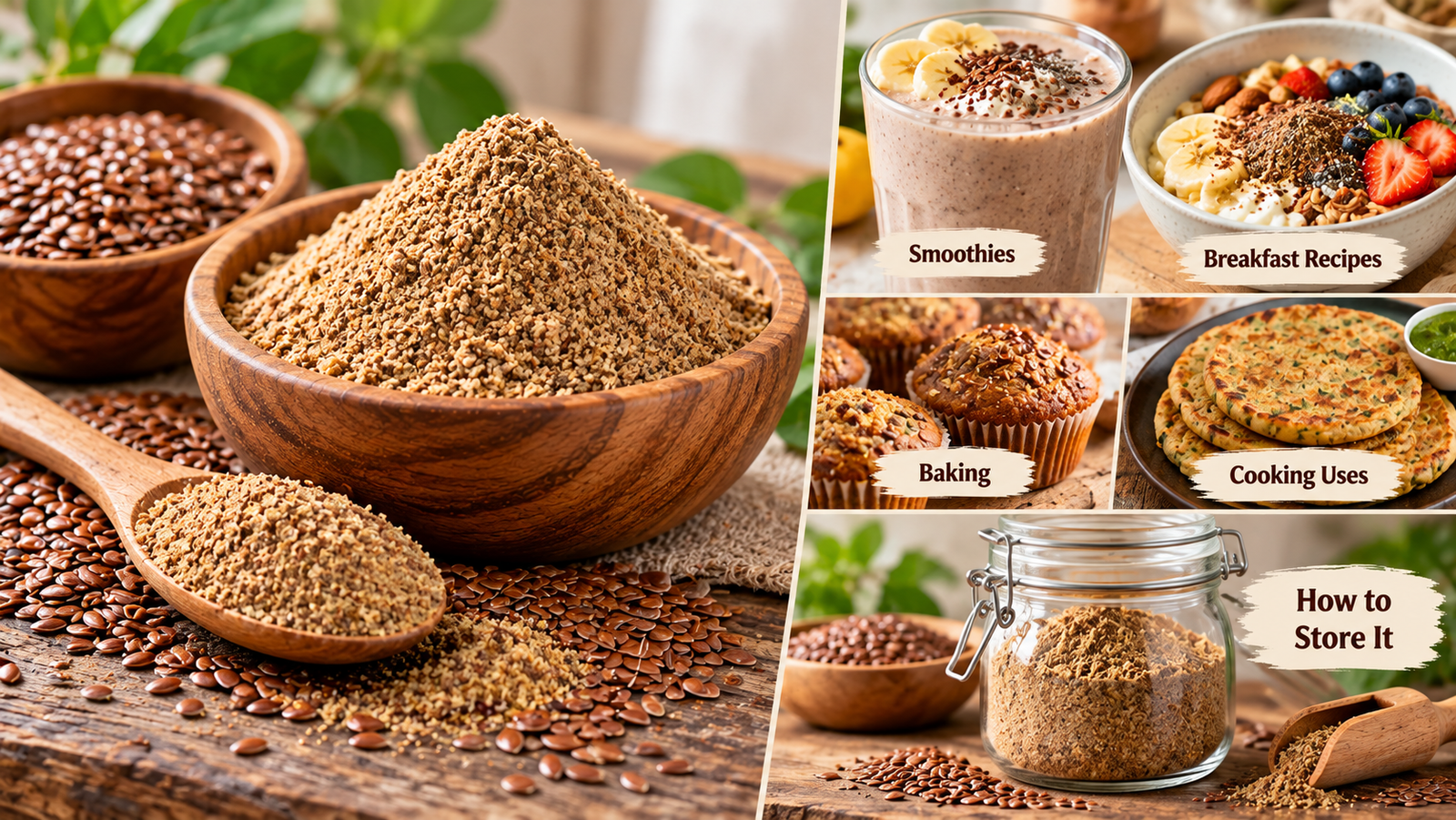
Flaxseed powder is roasted flax seed ground to a fine, slightly oily meal with a warm nutty taste. Indian kitchens use it as a dry seasoning: stirred into chutney podi, mixed into dosa batter and roti dough, sprinkled over curd rice, or bound with jaggery into laddu. It must be stored cool, because ground flax goes stale and bitter quickly.
If you have been looking for flaxseed powder for your everyday cooking, this guide covers only the kitchen side of it: how it tastes, how fine the grind should be, how it behaves in water and dough, which Indian dishes it suits, and how to keep it from turning. Farm2Home stocks flax seed powder in a 100g pack at Rs 199.50 and delivers across India.
The seed goes by different names depending on where you are. In Tamil it is ali vidai or aali virai, in Hindi alsi, in Telugu avise ginjalu, and in Kannada agase beeja. On packs and in recipes you will see both flaxseed powder and flax seed powder written as two words, and both refer to the same ground seed.
What flaxseed powder tastes like
Raw flax seed is bland and a little grassy. Roasting changes that completely. Once the seeds have been dry roasted on a tawa and ground, the powder smells toasty and tastes nutty, somewhere between roasted sesame and lightly browned groundnut, with a faint oily finish on the tongue.
That nuttiness is why it sits so naturally in South Indian podi. It does not fight with curry leaf, red chilli, urad dal or asafoetida. It fills in behind them and rounds off the sharp edges of the chilli. In sweet preparations it does the same job for jaggery, taking off the raw sugary edge.
The one thing to watch is bitterness. Flax carries a lot of its own oil, and that oil turns quickly once the seed coat is broken. A fresh pack tastes sweet and toasted. An old or badly stored one tastes sharp, varnish-like and bitter at the back of the throat, and no amount of chilli or jaggery will hide it. If your powder tastes bitter, do not try to rescue the dish. Throw it out and open a fresh pack.
How fine should the grind be?
Flax seed is small, hard and slippery, so home grinding often gives you a mix of powder and whole seeds that skate past the blades. Whole seeds in a podi are unpleasant to bite into and they make the mix look coarse and uneven.
A proper flax seed powder is uniformly fine, close to the texture of besan but slightly heavier in the hand because of the oil. It should not clump into a paste, and it should not be gritty. When you rub a pinch between your fingers it should feel soft and leave a very light film. That consistency is what lets it blend into batter and dough without anyone noticing a texture change.
Using flax seed powder in Indian cooking
The most useful thing to understand about this powder is what happens when it meets water. Stir a spoon of it into a few spoons of water and leave it for five to ten minutes. It swells and turns slippery and gel-like, almost like thin soaked sabja. This thickening behaviour is the whole trick behind most of its kitchen uses.
That means it does two different jobs depending on how you add it. Added dry, it is a nutty seasoning. Added with water, it is a binder and thickener. Deciding which one you want before you start will save you a lot of guesswork.
In chutney podi and milagai podi
This is the easiest place to begin. When you next make idli milagai podi, dry roast your urad dal, chana dal, red chillies, curry leaves and asafoetida as usual, and stir the flax powder in at the very end with the heat switched off. The residual warmth of the pan is enough. Do not roast the powder again over flame, because it is already roasted and it scorches fast.
Start at roughly one part flax powder to four parts of the rest of the podi mix. Taste it with a little gingelly oil on idli before you decide to add more. In a coriander or coconut chutney podi it works the same way, stirred in after grinding so the mix does not turn pasty from the extra oil.
In dosa batter, idli batter and roti dough
For dosa, mix the powder into the batter after it has fermented, not before. Add it to the batter just before you start making dosas, give it a good stir, and let it sit five minutes. The batter will thicken slightly, so keep a little water aside to loosen it back to pouring consistency. The dosas come out with a faint nutty taste and brown a shade darker than usual.
In roti and paratha dough it is even simpler. Add a spoon or two per cup of atta, mix it dry with the flour, then knead with water as normal. The dough feels a little softer and rolls out smoothly. For adai and dosa variants made with mixed dals, the same spoon-per-cup ratio works well.
Because of the way it gels, flax powder mixed with warm water is also a common binder in cutlets, tikkis and bonda mixes. Three spoons of water to one spoon of powder, rested for ten minutes, gives you a sticky slurry that holds a potato or vegetable mixture together while frying.
Sprinkled over curd rice, upma and poha
For a no-cooking use, keep a small jar of the powder on the table. A light sprinkle over thayir sadam just before eating gives the curd rice a toasted, savoury lift that goes especially well with a pickle on the side. The same works on upma, poha, lemon rice and even plain rice with ghee.
Do this at the point of serving rather than while cooking. The powder loses its toasted aroma if it sits in a hot pan or in warm curd for long, and in curd it will slowly thicken the whole bowl.
In laddu, chutney and sweets
Flax laddu is a familiar preparation in Maharashtrian and North Karnataka homes, often called alsi laddu. Melt jaggery into a soft syrup, switch off the flame, then fold in the flax powder along with roasted groundnut powder, grated dry coconut and a pinch of cardamom. Roll into balls while the mixture is still warm, because it stiffens as it cools.
You can also use a spoonful to thicken a wet chutney. If your tomato or coconut chutney has come out too watery, a little flax powder stirred in and rested for a few minutes will pull it together without changing the flavour much. In thalipeeth and multigrain flour blends, it folds in with jowar, bajra and rice flour without any adjustment.
Storing flaxseed powder so it does not turn
Ground flax is one of the more delicate things in an Indian pantry. Whole seeds keep for months on a shelf, but once ground, the surface is exposed to air and the oil in it starts to go off. Warmth and sunlight speed this up, which matters in most Indian kitchens for much of the year.
- Keep it in an airtight glass or steel jar, not in the opened pouch folded over.
- Store the jar in the refrigerator once the pack is opened. The fridge is the single biggest thing you can do to keep the taste clean.
- Keep it away from the stove, the window and the top of the fridge, all of which stay warm.
- Use a dry spoon every time. Any moisture that gets in will make the powder clump and gel in the jar.
- Buy small quantities often rather than one large pack. A 100g pack used within a few weeks will always taste better than a kilo that sits around.
- Smell it before each use. Fresh powder smells toasty. If it smells sharp or like old oil, it is finished.
Buying flax seed powder online in India
When buying, the two things that decide quality are how recently it was roasted and ground, and how it was packed. Look for a sealed pack rather than loose powder scooped from an open bin at a shop, where it has already been standing in warm air. Small pack sizes are a good sign, because they suggest the seller expects it to be used fresh.
Farm2Home sells ali vidai flaxseed powder in a sealed 100g pack at Rs 199.50, with delivery across India. The 100g size is a sensible quantity for a household using it in podi, dough and the occasional batch of laddu, and small enough to finish before the taste starts to drift.
Frequently asked questions
Does flaxseed powder need to be roasted before use?
If you buy it as ready powder it is already made from roasted seed, so no further roasting is needed and roasting it again will scorch it. If you are grinding whole flax seed yourself, dry roast the seeds on a low flame until they start to pop and smell toasty, cool them fully, then grind.
Why does my flaxseed powder taste bitter?
Bitterness means the powder has gone stale. The oil in ground flax turns quickly when it is kept warm or exposed to air, and once that happens the taste is sharp and unpleasant. Fresh powder tastes sweet and nutty. Store the jar in the refrigerator and buy small packs so this does not happen.
How much flax seed powder should I add to dosa batter or roti dough?
Start with one to two spoons per cup of batter or atta and taste from there. For dosa, stir it in after fermentation and keep extra water handy, since the batter thickens. For roti, mix it with the dry flour before kneading.
Can I store flaxseed powder outside the fridge?
It will keep for a short while in a sealed airtight jar in a cool dark cupboard, but Indian room temperatures are warm enough that the taste starts to drop off within a couple of weeks. The refrigerator is the safer place once the pack is open.
What is flaxseed powder called in Tamil, Hindi and Telugu?
Flax seed is ali vidai or aali virai in Tamil, alsi in Hindi, avise ginjalu in Telugu and agase beeja in Kannada. The ground form is sold as flaxseed powder, flax seed powder, alsi powder or ali vidai podi depending on the region.
Why does flaxseed powder become slimy in water?
Flax swells and releases a gel when it is mixed with water, which makes the mixture slippery and thick. This is normal and useful: it is why the powder works as a binder in cutlet and tikki mixes and as a thickener for watery chutney. To avoid it in a dish, add the powder dry and at the end.